Binance Card for GPT Site Users: Spending Your Crypto Earnings
Binance
 VERIFIED 2026
Quick answer
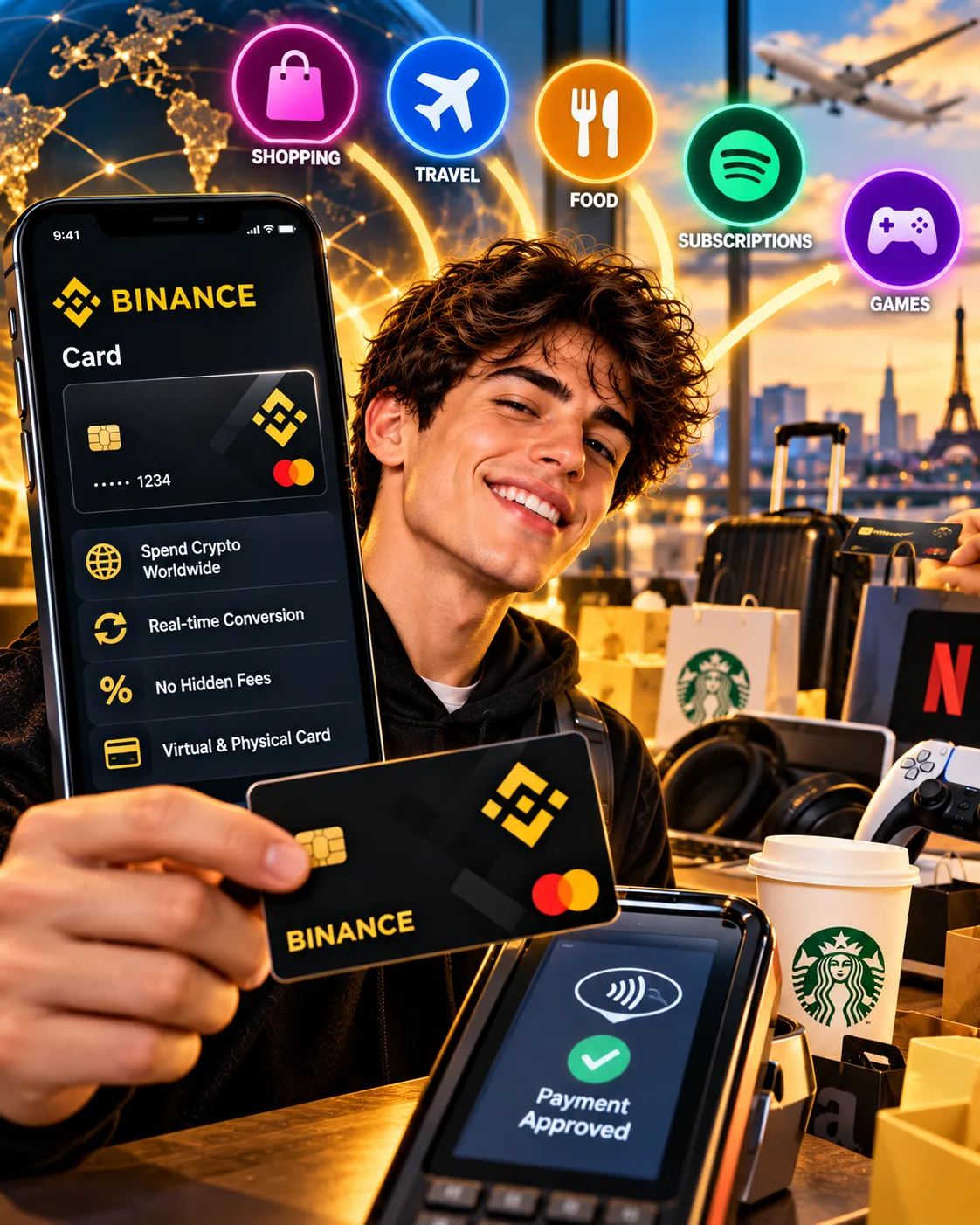
The Binance Card is a prepaid Mastercard that spends directly from your Binance account balance. For GPT site users who receive crypto payouts, it eliminates the final conversion step: instead of selling USDT on P2P and withdrawing to a bank account, you can spend the USDT directly at any Mastercard-accepting merchant.
The practical benefit is real: no P2P spread, no bank withdrawal delay, and no need to hold local currency. But the card is not available everywhere. After Visa and Mastercard severed their partnerships with Binance in December 2023, the card's geographic coverage shrank dramatically. The current product is a prepaid Mastercard available in Brazil, Australia, New Zealand, and Peru, with additional regional programs in select LATAM and MENA markets.
This guide examines what the Binance Card actually is, the real fee structure, availability by country, the cashback tiers, and how it compares to the alternatives for GPT users.
The Short Answer: Is the Binance Card Worth It for GPT Users?
Yes, if you live in a supported country and already hold crypto on Binance. The Binance Card converts your GPT crypto earnings into spendable fiat at the point of sale, with a 0.9% conversion fee and no annual or issuance fees. The cashback tiers range from 0.1% to 8% in BNB, depending on your average BNB holdings.
But the card is not available in the United States, Canada, the EEA, or the United Kingdom. The old Visa card that covered Europe was shut down in December 2023 and has not been replaced. For users in those markets, the Binance Card is not an option — you would need a different crypto card or continue using the P2P cashout route.
For a full review of how Binance works for GPT users, including the fee structure and P2P cashout process, see our Binance review for GPT site payouts.
What the Binance Card Actually Is
The Binance Card is a prepaid Mastercard issued in partnership with regional payment processors. It is not a credit card and not a debit card linked to a bank account. It is funded from your Binance spot wallet or funding account, and it converts your crypto to fiat automatically when you make a purchase.
| Feature | Details |
|---|---|
| Card type | Prepaid Mastercard (virtual and physical) |
| Funding source | Binance spot wallet or funding account |
| Supported assets | USDT, USDC, FDUSD, BNB, BTC, ETH, SOL, ADA, LINK, XRP, and others |
| Conversion | Automatic at point of sale |
| Annual fee | Free |
| Issuance fee | Free |
| Cashback | 0.1% to 8% in BNB, based on average BNB holdings |
| Availability | Brazil, Australia, New Zealand, Peru, and select LATAM/MENA markets |
The card is custodial: your funds are held on Binance, not in a self-custody wallet. When you spend, Binance converts your chosen crypto to the local fiat currency at the point of sale and settles the transaction with the merchant through Mastercard.
For a step-by-step guide on receiving GPT crypto payouts into Binance, see our tutorial on withdrawing GPT crypto to Binance.
Binance Card Fees: What You Actually Pay
The Binance Card has one of the simplest fee structures among crypto cards: no annual fee, no issuance fee, and a flat conversion fee on every transaction.
| Fee type | Amount | Notes |
|---|---|---|
| Annual fee | Free | No annual or monthly card fee |
| Issuance fee | Free | Virtual card issued instantly; physical card free |
| Crypto conversion fee | 0.9% | Applied when crypto is converted to fiat at the point of sale |
| Foreign exchange fee | 1–2% | Applied when spending in a currency other than your card's base currency |
| ATM withdrawal fee | 2 free per month, then $1.50 each | Applies to cash withdrawals at ATMs |
| Physical card cancellation (within 1 year) | 30 BRL (Brazil) | No fee if cancelled after 1 year |
On a $25 GPT payout in USDT, spending directly with the Binance Card costs $0.225 (0.9%) instead of the P2P spread and bank withdrawal fees. That is a meaningful saving for frequent small transactions.
The foreign exchange fee (1–2%) applies when you spend in a currency different from your card's base currency. For GPT users in Brazil spending in BRL, the FX fee does not apply to domestic transactions. For users in other markets, the FX fee is the main additional cost beyond the 0.9% conversion fee.
For a detailed breakdown of Binance fees on small crypto withdrawals, see our guide to Binance fees for small crypto withdrawals.
Cashback Tiers: How the BNB Holding Model Works
Binance Card cashback is entirely BNB-holding-based. Your average BNB balance over the previous month determines your card level (1–5) and the corresponding cashback rate (0.1% to 8%).
| Card level | Average BNB holdings | Cashback rate | Monthly cap |
|---|---|---|---|
| Level 1 | 0 BNB | 0.1% | 250 BRL (~$45) |
| Level 2 | 1–10 BNB | 0.5% | 250 BRL (~$45) |
| Level 3 | 10–100 BNB | 1% | 250 BRL (~$45) |
| Level 4 | 100–600 BNB | 2% | 250 BRL (~$45) |
| Level 5 | 600+ BNB | 8% | 250 BRL (~$45) |
The cashback is paid in BNB at the end of each month. This means the cashback value fluctuates with the BNB price. For users who are already long BNB, this is fine. For users who want stable cashback value, it introduces price risk.
The 8% ceiling requires holding 600 BNB, which is a substantial position (worth tens of thousands of dollars at current rates). Most GPT users will fall into Level 1 or Level 2, earning 0.1% to 0.5% cashback. The cashback is a nice bonus but not the primary reason to use the card.
For a comparison of Binance Card cashback against other crypto cards, see our Binance vs Coinbase vs Kraken comparison.
Country Availability: Where the Binance Card Works
This is the biggest limitation. After the Visa program shut down in December 2023, the Binance Card's coverage shrank to a handful of markets.
| Region | Binance Card availability | Notes |
|---|---|---|
| Brazil | Yes | Primary market; up to 3% BRL cashback |
| Australia | Yes | Verified country-level availability |
| New Zealand | Yes | Verified country-level availability |
| Peru | Yes | Verified country-level availability |
| Colombia, Armenia, Kazakhstan, Uzbekistan | Regional programs | Limited availability; check in-app |
| EEA (Germany, France, etc.) | No | Visa program closed December 2023; no MiCA-compliant relaunch announced |
| United Kingdom | No | Visa program closed December 2023 |
| United States | No | Never available |
| Canada | No | Never available |
For GPT users in Brazil, the Binance Card is a practical option. For users in Europe, the UK, the US, or Canada, the card is not available, and you would need to use the P2P cashout route or a different crypto card.
The Binance Card's availability is determined by the regulatory environment in each market. After the DOJ settlement and the Visa/Mastercard partnership termination in 2023, Binance lost its ability to issue cards in most Western markets. The current product operates where Binance has stronger regulatory standing.
For a full review of Binance's country availability and regulatory status, see our Binance review for GPT site payouts.
How to Get the Binance Card
The application process is straightforward if you live in a supported country.
- Complete Binance KYC. You need a verified Binance account before you can apply for the card.
- Go to the Cards section. In the Binance app, tap "Cards" in the menu or home screen.
- Select "Apply for Binance Card." The app will check your country of residence against the supported list.
- Choose the card format. You can order a virtual card (issued instantly) or a physical card (mailed to your address, free in most markets).
- Set your payment priority. Choose the order in which Binance should deduct crypto from your balance when you spend. USDT and USDC are the most common choices for GPT users.
- Add the virtual card to Apple Pay or Google Pay. You can start spending immediately, even before the physical card arrives.
The virtual card is issued instantly and can be used online or added to a digital wallet. The physical card takes longer to arrive but allows ATM withdrawals and in-person payments at merchants that do not accept contactless mobile payments.
For a full guide on Binance KYC requirements, see our Binance KYC for GPT crypto earnings.
Binance Card vs Alternatives for GPT Users
The Binance Card is not the only option for spending crypto. Here is how it compares to the main alternatives for GPT users.
| Card | Cashback | Annual fee | Availability | Best for |
|---|---|---|---|---|
| Binance Card | 0.1%–8% BNB | Free | Brazil, Australia, NZ, Peru, select LATAM | Binance users in supported countries |
| Crypto.com Visa | 1%–5% CRO | Free (staking required) | Global (not US) | Users willing to stake CRO |
| Coinbase Card | Up to 4% | Free | US only (not NY) | US users who want simplicity |
| Bybit Card | Up to 10% points | Free | EEA, APAC, LATAM, select markets | Bybit ecosystem users |
| RedotPay | None | Free | Global | Users who want a simple crypto spending card |
The Binance Card's main advantage is its integration with the Binance ecosystem. If you already receive GPT payouts on Binance, the card lets you spend those earnings directly without an extra conversion step. The main limitation is geographic: if you are not in a supported country, the card is not an option.
For a comparison of Binance against Coinbase and Kraken on fees and features, see our Binance vs Coinbase vs Kraken comparison.
Verdict: Is the Binance Card Worth It for GPT Site Users?
Yes, if you live in a supported country and already hold crypto on Binance. The card eliminates the final conversion step between GPT crypto payouts and spending. The 0.9% conversion fee is reasonable, and the cashback (even at the base tier) is a nice bonus.
Use the Binance Card if:
- You live in Brazil, Australia, New Zealand, Peru, or another supported market
- You receive GPT crypto payouts into Binance
- You want to spend your crypto directly without converting to fiat first
- You are comfortable with the custodial model (Binance holds your funds)
Skip the Binance Card if:
- You live in the EEA, UK, US, Canada, or another unsupported market
- You prefer self-custody and do not want Binance holding your funds
- You need a card that works in a currency not supported by the card's base currency
- You do not hold BNB and do not want BNB price risk on your cashback
For GPT users who receive fiat (USD, EUR) from sites, the Binance Card is not relevant — you would use a traditional bank card. The Binance Card is specifically useful for users who receive crypto payouts and want to spend them directly.
For a full review of Binance as a GPT payout destination, see our Binance review for GPT site payouts. For KYC requirements, see our Binance KYC for GPT crypto earnings. For P2P cashout, see our Binance P2P guide for GPT earnings.
Frequently Asked Questions
What is the Binance Card?
The Binance Card is a prepaid Mastercard that spends directly from your Binance account balance. It converts your crypto to fiat at the point of sale, with a 0.9% conversion fee and no annual or issuance fees.
Is the Binance Card available in my country?
The Binance Card is currently available in Brazil, Australia, New Zealand, Peru, and select LATAM/MENA markets. It is not available in the EEA, UK, US, or Canada.
What is the Binance Card cashback rate?
Cashback ranges from 0.1% to 8% in BNB, depending on your average BNB holdings over the previous month. Most GPT users will fall into the 0.1% to 0.5% range. The 8% ceiling requires holding 600 BNB.
What fees does the Binance Card charge?
The card has no annual fee and no issuance fee. It charges a 0.9% crypto conversion fee on every transaction, a 1–2% foreign exchange fee for non-base currency spending, and an ATM withdrawal fee of $1.50 after two free withdrawals per month.
Can I use the Binance Card for GPT earnings?
Yes. If you receive GPT crypto payouts into Binance, you can spend those earnings directly with the card. This eliminates the need to sell on P2P and withdraw to a bank account. The 0.9% conversion fee is the only cost on domestic transactions.
Does the Binance Card work with Apple Pay or Google Pay?
Yes. The virtual card can be added to Apple Pay or Google Pay and used for contactless payments in stores and online. The physical card also supports contactless payments.
Is the Binance Card safe?
The card is custodial, meaning Binance holds your funds. It is protected by Binance's security infrastructure (2FA, anti-phishing code, SAFU fund for exchange hacks). However, the card is not a bank card and does not have deposit protection like a traditional bank account.
What happens if I cancel the Binance Card?
In Brazil, cancelling the physical card within 1 year of issuance costs 30 BRL. Cancelling after 1 year is free. The virtual card can be deleted at any time without a fee.
Can I use the Binance Card in the EEA or UK?
No. The Binance Card program in the EEA and UK was discontinued in December 2023 when Visa and Mastercard severed their partnerships with Binance. There is currently no announced relaunch in those markets.
Do I need to pay taxes on Binance Card spending?
Tax treatment depends on your country. In most jurisdictions, spending crypto is a taxable event, and capital gains may apply. In Germany, crypto gains are tax-free after one year of holding. In France, a flat tax of 30% applies on capital gains with an annual allowance of €305. Consult a local tax advisor for guidance specific to your situation.
Get the Ultimate GPT Insider Guide🚀
Learn how survey disqualifications work and proven ways to qualify for more studies. 100% Free.
LootHub.org
Recommended posts
Continue with these related reward guides.
 VERIFIED 2026
Binance Review for GPT Site Users: The Best Crypto Withdrawal Option?
 VERIFIED 2026
Binance Alternatives for GPT Crypto Withdrawals: Coinbase, Kraken & More
 VERIFIED 2026
Binance Fees for Small Crypto Withdrawals from GPT Sites: What You Actually Pay
 VERIFIED 2026
Binance vs Coinbase vs Kraken for GPT Crypto Payouts: Which One Should You Use?
 VERIFIED 2026
Binance KYC for GPT Crypto Earnings: Documents, Limits & Verification
 VERIFIED 2026