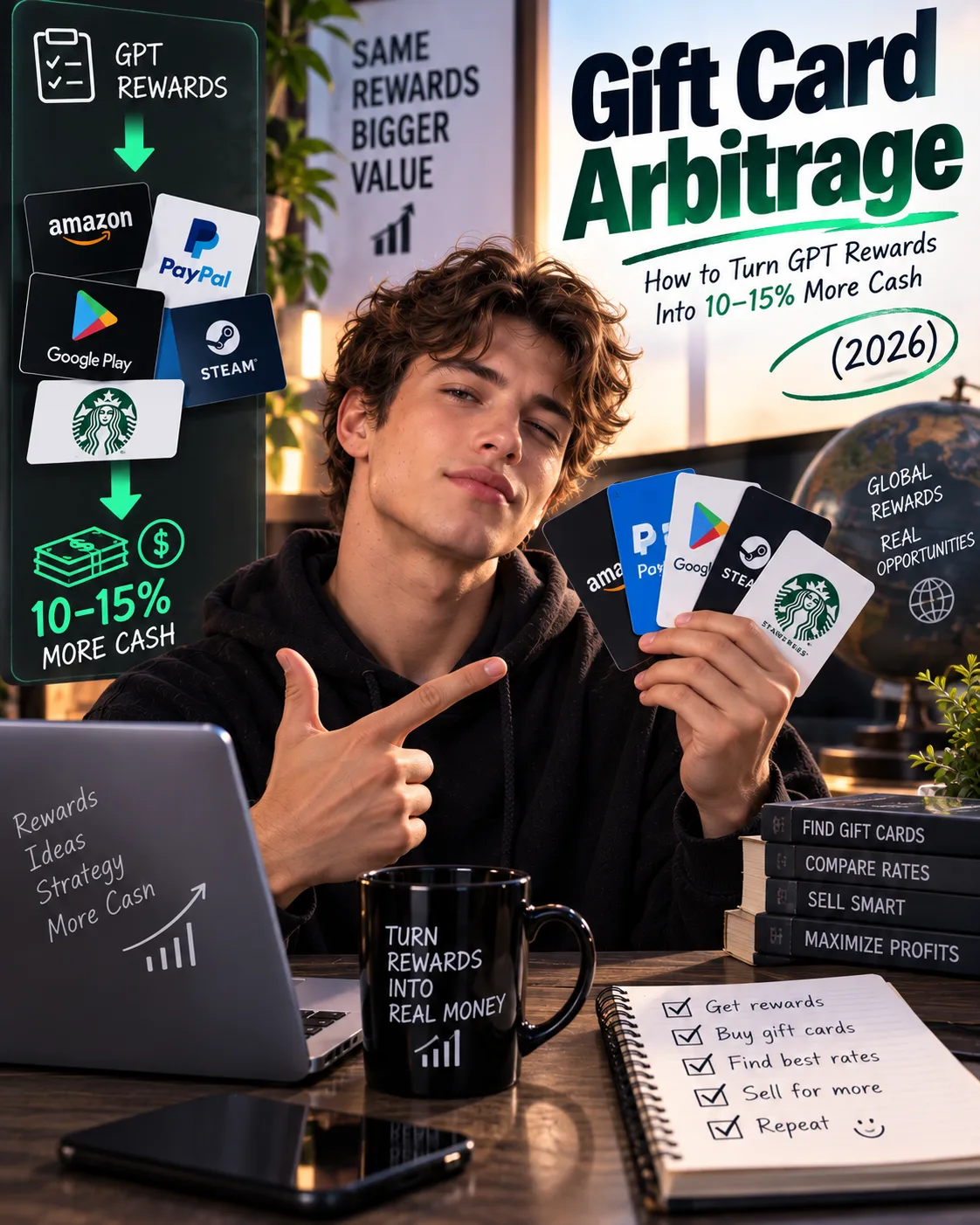
Gift Card Arbitrage: How to Turn GPT Rewards Into 10–15% More Cash (2026)
FreeCash
 VERIFIED 2026
Quick answer
Gift card arbitrage works when the discount you get on a GPT site exceeds the resale loss on a secondary marketplace. In practice, that means CardCash (75–92% payout), GiftCash (80–93%), or Gameflip (8% + 2% + 2% fees) for US users, and Gutscheinplaza or eBay Kleinanzeigen in Germany. The winning formula is simple: choose gift cards with high resale rates, avoid platforms with commission structures that eat the spread, and only arbitrage when the GPT platform’s gift card discount is at least 10–15% better than its PayPal rate.
Most GPT users cash out in PayPal because it is simple. But on many platforms, the gift card option is quietly more valuable. Freecash, Swagbucks, and PrizeRebel all offer gift cards at a lower point cost than the equivalent in PayPal cash. That gap — sometimes 5%, sometimes 15% — is the raw material for gift card arbitrage. Whether it is worth capturing depends on the platform, the retailer, and the fees involved. This guide breaks down the real numbers.
What Is Gift Card Arbitrage?
Gift card arbitrage is the practice of acquiring a gift card at a discount and reselling it for cash at a higher rate than you paid. In the GPT context, it works like this:
- You earn points on a GPT site by completing offers, surveys, or tasks.
- You redeem those points for a gift card instead of PayPal cash, often at a better exchange rate.
- You resell the gift card on a secondary marketplace for 75–93% of its face value.
- You keep the difference between the GPT gift card discount and the resale loss.
The logic is the same as currency arbitrage: you buy low in one market and sell high in another. But the spread is smaller, the fees are higher, and the tax treatment is more complicated than most guides suggest.
The Real Math: GPT Gift Card Rates vs. PayPal Rates
The first variable is the GPT platform’s own exchange rate. Here is how the major platforms compare on a $10 redemption:
| Platform | PayPal Cost for $10 | Gift Card Cost for $10 | Gift Card Discount |
|---|---|---|---|
| Freecash | 10,000 points ($10) | ~9,500–10,000 points (varies by retailer) | 0–5% |
| Swagbucks | 1,000 SB ($10) | ~900–1,000 SB (varies by retailer) | 0–10% |
| PrizeRebel | 1,000 points ($10) | ~900–1,000 points (varies by retailer) | 0–10% |
| ySense | 10,000 points ($10) | ~9,500–10,000 points | 0–5% |
The discount varies by retailer and by platform. Amazon gift cards are usually the most expensive to redeem (lowest discount) because Amazon is the most in-demand. Less popular retailers — coffee chains, specialty stores, restaurant chains — often carry a 5–15% discount because the platform is trying to move inventory that users do not want.
The key takeaway: the discount is not uniform. You need to check the specific rate for the specific retailer on the specific platform. A gift card that costs 10% less on Freecash might cost the same as PayPal on Swagbucks.
The Second Half: Resale Rates on Secondary Markets
Once you have the gift card, you need to sell it. The resale rate determines whether the arbitrage is profitable.
| Platform | Typical Payout Range | Fees | Payout Speed | Best For |
|---|---|---|---|---|
| CardCash | 75–92% | None (built into the offer) | 24 hours to 3 days | Popular brands (Amazon, Walmart, Target) |
| GiftCash | 80–93% | None | 1–2 days | Highest payout rates, reliable offers |
| Raise (GCX) | 70–90% | 15% commission on sale price | Varies by buyer | Sellers who want to set their own price |
| Gameflip | 70–95% (you set price) | 8% + 2% partner + 2% digital | 1–3 days | Gaming gift cards (Steam, Xbox, PlayStation) |
| CardPool | Up to 92% | None | 1–3 days | Simpler interface, US-focused |
CardCash and GiftCash are instant buyers. You submit the card, they give you an offer, and you accept or decline. The offer is typically 75–92% of face value, depending on the brand. Amazon cards get the best rates (often 88–92%). Less popular brands get less — sometimes as low as 70%.
Raise is a marketplace. You set your own price, and Raise takes a 15% commission when the card sells. That means if you sell a $100 card for $90, you receive $76.50 after the commission. The effective payout is 76.5% — lower than CardCash’s instant offer for the same brand, unless you price the card higher and find a buyer willing to pay.
Gameflip is a marketplace for gaming cards. The fee structure is 8% commission + 2% partner fee + 2% digital fee for digital-only sales — a total of 12% before any fixed fees. For a $50 Steam card sold at $45, you receive approximately $39.60 after fees. That is 79.2% of face value.
The Combined Math: Does Arbitrage Actually Pay?
Here is a realistic example using Swagbucks and CardCash:
- You earn 1,000 SB through surveys and offers.
- You redeem 900 SB for a $10 Amazon gift card (10% discount vs. PayPal’s 1,000 SB).
- You sell the $10 Amazon card on CardCash for $8.80 (88% payout).
- You receive $8.80 in cash.
If you had redeemed 1,000 SB for $10 PayPal instead, you would have received $10. But you only spent 900 SB on the gift card and got $8.80 back. On a per-SB basis:
- PayPal: $10 / 1,000 SB = $0.0100 per SB.
- Gift card arbitrage: $8.80 / 900 SB = $0.0098 per SB.
In this example, PayPal is slightly better. The 10% gift card discount is not enough to overcome the 12% resale loss. The arbitrage only works if the gift card discount exceeds the resale loss by a meaningful margin.
The break-even point depends on the resale rate. If you can sell an Amazon card for 92% and get a 10% gift card discount, the math is:
- $10 card sold for $9.20 / 900 SB = $0.0102 per SB.
That is 2% better than PayPal. The margin is thin but real. If the gift card discount is 15% and the resale rate is 92%, the effective rate is $0.0108 per SB — 8% better than PayPal.
The conclusion: arbitrage only works when the GPT gift card discount is at least 10–15% and the resale rate is at least 85%. Below those thresholds, the fees and the spread eat the profit.
When Gift Card Arbitrage Is Worth It
Based on the math above, gift card arbitrage is worth considering in these scenarios:
- The GPT platform offers a 15%+ discount on a gift card you can resell at 85%+. This is the sweet spot. You need both a high discount and a high resale rate.
- You are already planning to sell the gift card on a marketplace. If you were going to list it on CardCash or GiftCash anyway, the arbitrage is a natural extension of an existing habit.
- You have a high-volume GPT account. The margins are small. On a $10 redemption, the difference might be $0.20. On a $100 redemption, it might be $2.00. Arbitrage makes more sense at higher volumes.
- You are in a country where PayPal fees are high. If PayPal charges a currency conversion fee or a withdrawal fee in your country, the gift card route may be more competitive than it looks.
When Gift Card Arbitrage Is Not Worth It
Arbitrage does not pay in these scenarios:
- The GPT gift card discount is less than 10%. The resale loss will exceed the discount, and you will end up with less cash than PayPal would have given you.
- The resale rate is below 85%. Even with a 15% gift card discount, a 80% resale rate leaves you with a net loss compared to PayPal.
- You are redeeming small amounts. On a $5 gift card, the absolute difference might be $0.10. The time spent listing and selling is not worth it.
- The gift card is for a less popular brand. Amazon and Visa cards have the best resale rates. Cards for specialty retailers, restaurants, or regional chains often sell for 70–80% — a loss that wipes out the arbitrage.
- You are in Germany or France. The secondary market for gift cards is less developed than in the US. Gutscheinplaza and Place des Cartes have lower resale rates and smaller buyer pools. PayPal or SEPA is almost always the better choice for European users.
How to Execute Gift Card Arbitrage (Step by Step)
- Check the GPT platform’s gift card rates. Look for the retailer with the highest discount relative to PayPal. Amazon is usually the most in-demand but also the most expensive; niche retailers may have deeper discounts.
- Check the resale rate on a secondary marketplace. Use CardCash, GiftCash, or Gameflip to get an instant quote for the specific retailer. Do this before you redeem — the resale rate may have changed.
- Calculate the effective rate per point or per SB. Divide the resale cash by the points spent. Compare it to the PayPal rate (points spent divided by PayPal cash). If the gift card rate is higher, proceed.
- Redeem the gift card. Do not redeem a large amount at once. Start with one card to test the process.
- Sell the gift card on the marketplace. Submit the card code or number. CardCash and GiftCash give instant offers. Raise and Gameflip require you to set a price and wait for a buyer.
- Track the payout. CardCash pays within 24 hours to 3 days. Raise and Gameflip pay after the buyer confirms receipt.
- Document everything for tax purposes. See the next section.
Taxes and Legal Considerations
Gift card arbitrage has tax implications that most guides ignore. Here is what you need to know in the major markets.
United States
The IRS treats gift card sales as taxable income if they are part of a profit-seeking activity. If you are buying and reselling gift cards regularly with the intent to profit, the gains are self-employment income. You must report them on Schedule C and pay self-employment tax.
The record-keeping burden is substantial. You need to track the original cost (in points or cash), the resale price, and any fees. For high-volume arbitrage, this can become a full accounting exercise.
Germany
In Germany, the resale of gift cards is subject to different rules depending on whether the card is a Einzweck-Gutschein (single-purpose voucher) or a Mehrzweck-Gutschein (multi-purpose voucher). The distinction, which has been clarified by the European Court of Justice and the German Federal Fiscal Court (BFH), determines the VAT treatment.
For Einzweck-Gutscheine — where the place of supply and the VAT rate are known at the time of issue — the transfer is subject to VAT. For Mehrzweck-Gutscheine — where the place of supply is not determined until redemption — the resale is subject to VAT as a separate service.
For a private individual selling an occasional gift card, the practical implication is limited: occasional private sales are generally not subject to VAT or income tax. But if you are buying and reselling gift cards regularly with the intent to profit, the tax office may classify it as a gewerbliche Tätigkeit (commercial activity), requiring a Gewerbeanmeldung and VAT registration if turnover exceeds the Kleinunternehmer threshold (€25,000 previous year / €100,000 current year).
In practice, gift card arbitrage in Germany is rare because the secondary market is less developed. Gutscheinplaza exists, but the resale rates are lower than in the US, and the buyer pool is smaller. Most German GPT users are better served by cashing out via PayPal or SEPA.
France
In France, the resale of gift cards is a cession de biens mobiliers (sale of movable property). For a private individual, occasional sales are not subject to income tax. But if the activity is regular and profit-seeking, it may be classified as bénéfices non commerciaux (BNC) or bénéfices industriels et commerciaux (BIC), with the same micro-enterprise thresholds as other online activities.
The DAC7 framework, which requires digital platforms to report user income to the tax authority, applies if you exceed €2,000 in revenue or 30 transactions in a year. For most casual arbitrage users, this threshold is not reached. But if you are reselling gift cards regularly, the platform may report the activity, and the tax authority may classify it as professional income.
United Kingdom
HMRC treats gift card resale as a trading activity if it is regular and profit-seeking. The £1,000 trading allowance covers most casual sellers. Above that threshold, the income must be declared. VAT may apply if the activity is commercial and turnover exceeds the VAT registration threshold (£90,000 as of 2026).
Canada
The CRA treats gift card resale as business income if it is regular and profit-seeking. Report on Form T2125 if the activity is business income. The GST/HST registration threshold ($30,000 over four consecutive quarters) applies to commercial activity.
Risks of Gift Card Arbitrage
Beyond the tax implications, gift card arbitrage carries several risks:
- Fraudulent cards. If you buy a gift card that was purchased with a stolen credit card, the retailer may cancel it after you have already sold it. The buyer will dispute the sale, and you will be left with the loss. This is a common problem in the gift card resale market.
- Marketplace disputes. If the buyer claims the card does not work or has a lower balance than advertised, the marketplace may freeze your payout or reverse the sale. The burden of proof is on you.
- Account suspension on GPT platforms. Some GPT sites prohibit the resale of gift cards obtained through their platform. Check the terms of service before you start. Freecash and Swagbucks do not explicitly prohibit resale, but the practice may fall under “commercial use” restrictions.
- Time cost. The margin is small. If you spend 30 minutes listing and selling a $10 gift card to earn an extra $0.20, your hourly rate is $0.40. That is worse than any GPT task.
- Legal ambiguity. In some jurisdictions, the legality of gift card resale is unclear. The EU’s VAT rules for multi-purpose vouchers are complex, and the treatment varies by country. If you are arbitraging at scale, consult a tax advisor.
Alternatives That Are Simpler and Almost As Profitable
For most users, the time and complexity of gift card arbitrage are not worth the marginal gain. Simpler alternatives include:
- Cash out via PayPal. The rate is predictable, the process is simple, and the tax treatment is straightforward. You give up the arbitrage margin, but you save the time and the risk.
- Use gift cards for their face value. If you are going to shop at Amazon or a specific retailer anyway, redeeming a gift card at a discount is a guaranteed saving without the resale hassle. A $100 Amazon gift card for 90,000 SB instead of 100,000 SB is a 10% saving on your purchase.
- Use SEPA transfers in Europe. Freecash offers SEPA transfers for German and French users. The 5% fee is comparable to the spread you would lose on arbitrage, and the process is simpler.
- Focus on higher-paying GPT tasks. Instead of trying to squeeze an extra 5% out of gift card arbitrage, spend the same time on a higher-paying offer or survey. The hourly rate is better, and there is no resale risk.
Frequently Asked Questions
Is gift card arbitrage legal?
In most jurisdictions, reselling gift cards is legal for private individuals. The legal risks arise when the activity becomes regular and profit-seeking, which may trigger business registration and VAT obligations. The legality of the arbitrage itself — buying low and selling high — is not in question. What matters is the tax treatment.
How much can I make from gift card arbitrage?
The margin is typically 2–8% of face value, assuming a 10–15% gift card discount and an 85–92% resale rate. On a $100 redemption, that is $2–$8. The margin is small, and the time cost often exceeds the gain. Arbitrage is only worthwhile at high volumes or when combined with other strategies.
Which gift cards have the best resale rates?
Amazon gift cards consistently have the highest resale rates (88–92% on CardCash). Walmart, Target, and Visa cards are also in high demand. Gaming cards (Steam, Xbox, PlayStation) do well on Gameflip. Less popular retailers — restaurants, specialty stores, regional chains — have lower rates (70–80%).
What is the best platform to sell gift cards?
For instant payout, CardCash and GiftCash are the best options in the US. For gaming cards, Gameflip is the best. For sellers who want to set their own price, Raise is an option, but the 15% commission reduces the effective payout.
Can I do gift card arbitrage in Germany or France?
It is possible but harder. Gutscheinplaza (Germany) and Place des Cartes (France) exist, but the resale rates are lower and the buyer pool is smaller than in the US. For most European users, PayPal or SEPA is simpler and more profitable.
Do I have to pay taxes on gift card resale?
If you are selling gift cards occasionally, the gains are usually not taxable. If you are buying and reselling regularly with the intent to profit, the gains are business income and must be declared. In Germany, France, the UK, and Canada, the activity may trigger business registration and VAT registration if turnover exceeds the relevant thresholds.
What happens if the buyer disputes the gift card sale?
The marketplace may freeze your payout or reverse the sale. If the buyer claims the card does not work or has a lower balance than advertised, you may need to provide proof of the original balance. Keep records of the card balance at the time of sale.
Is gift card arbitrage worth it compared to other GPT strategies?
For most users, no. The margin is small, the time cost is high, and the tax complications are disproportionate to the gain. Other strategies — cashing out via PayPal, using gift cards for personal spending, or focusing on higher-paying tasks — are simpler and often more profitable on an hourly basis.
Bottom Line
Gift card arbitrage is a legitimate strategy, but the margin is thinner than most guides suggest. The math only works when the GPT platform offers a 10–15% discount on a gift card that can be resold at 85–92% of face value. Below those thresholds, PayPal is the better choice.
For most users, the time and complexity are not worth the marginal gain. Cashing out via PayPal, using gift cards for personal spending, or focusing on higher-paying tasks are simpler and more predictable. Gift card arbitrage is a strategy for power users who already track their GPT earnings closely and want to squeeze out every last percentage point. If that describes you, the numbers in this guide should give you a starting point. If not, PayPal remains the pragmatic choice.
Get the Ultimate GPT Insider Guide🚀
Learn how survey disqualifications work and proven ways to qualify for more studies. 100% Free.
LootHub.org
Recommended posts
Continue with these related reward guides.
 VERIFIED 2026
Best GPT Sites in Austria & Switzerland 2026: Guide for English Speakers & Expats
 VERIFIED 2026
Freecash Referral Program: How to Earn $12.50+ Per Friend (2026 Country Breakdown)
 VERIFIED 2026
JumpTask vs Freecash vs Swagbucks 2026: Which Microtask Platform Actually Pays Best?
 VERIFIED 2026
Freecash Withdrawal Guide 2026: PayPal, SEPA, Crypto — Fees, KYC & Real Timelines
 VERIFIED 2026
Best GPT Sites in Germany 2026: Honest Guide for Serious Earners
 VERIFIED 2026