GPT Site Account Banned? Causes, Appeals and How to Recover Your Balance
FreeCash
 VERIFIED 2026
Quick answer
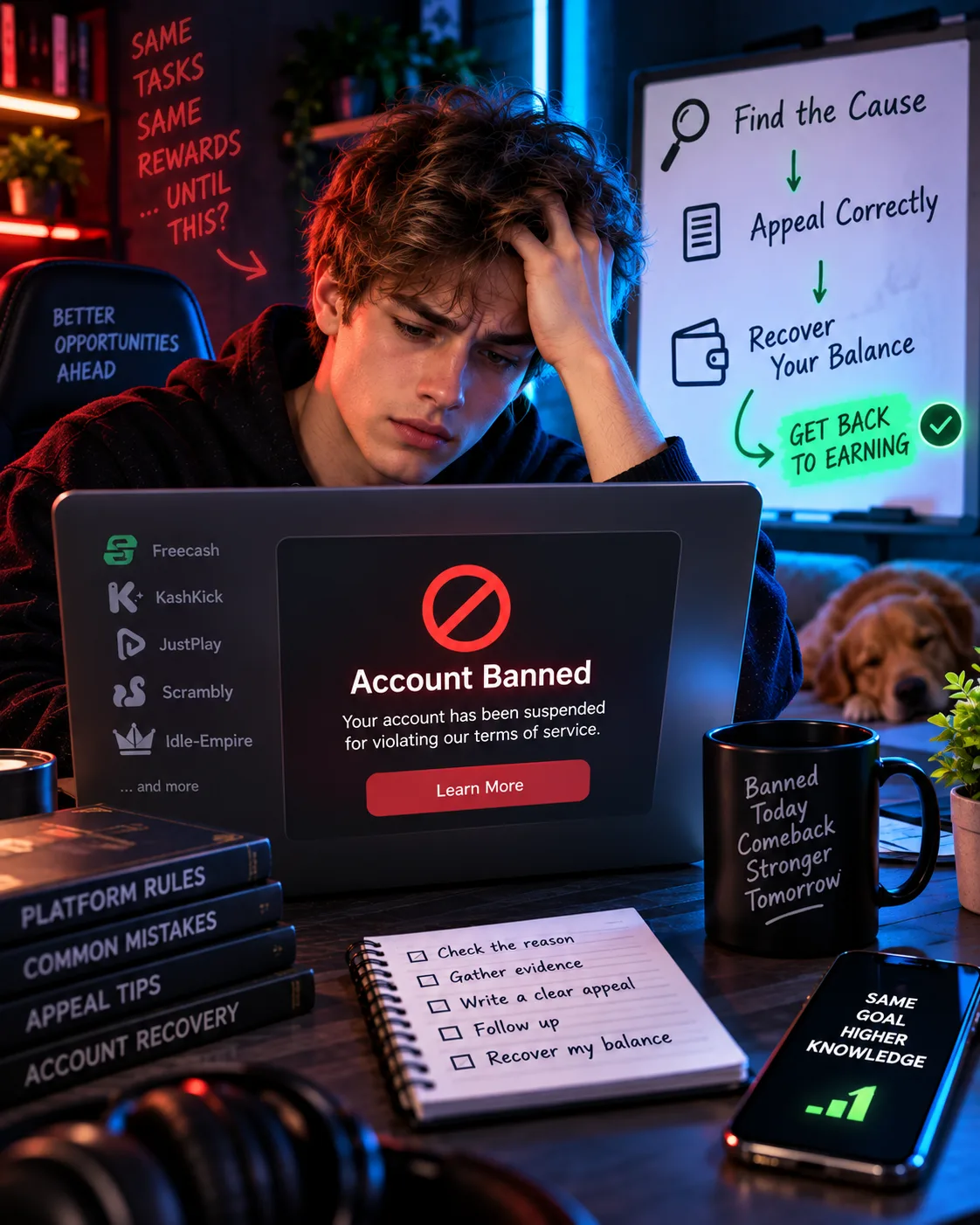
You log in to request a payout — and instead you see a message that your account has been suspended. No warning, no explanation, no withdrawal button. Just a blank dashboard and the question of whether weeks of work were wasted.
This is one of the most frustrating situations in the GPT space. And it's more common than the platforms admit. The good news: a ban does not automatically mean your balance is lost. In many cases it can be reversed — if you know why it happened and how to respond.
This guide breaks down the eight most common ban triggers, how to write an appeal that actually gets read, which platforms are more likely to reverse a ban, and when it's time to write off the balance and move on.
Quick answer: what to do when your account gets banned
If your GPT account has been suspended, work through this order:
- Read the ban message carefully. If it names a specific reason (VPN detected, duplicate account, KYC failure), you have your angle for the appeal.
- Check the platform's terms of service. Look for what constitutes a violation — and whether the platform states anything about paying out balances on suspended accounts.
- Open one support ticket. Stay factual. Ask for an explanation, not for the payout. Angry messages get ignored faster.
- Use official escalation channels. Some platforms (Freecash, for example) run dedicated Reddit threads or community channels where bans get reviewed.
- Set a deadline. If you hear nothing after 14 days, review the platform publicly (Trustpilot, Reddit) and move on. For some platforms, that's the only thing that forces a response.
What not to do: don't open a second account, don't threaten legal action over small balances, don't message the CEO on LinkedIn. Those moves almost always make things worse.
The 8 most common ban reasons
| Reason | How to recognize it | Chance of reversal | What to do |
|---|---|---|---|
| 1. VPN / proxy detected | Message mentions "VPN," "proxy," or "unusual IP" | Medium | Disable the VPN, contact support, explain (privacy habit, not country-evasion) |
| 2. Duplicate account | Message mentions "duplicate account" or "linked accounts" | Low | Identify the original account, negotiate payout of the primary balance |
| 3. KYC failure | Verification rejected, account frozen | High | Submit a different ID, fix the issue (photo quality, expiry date) |
| 4. Suspected bot / automation | "unusual activity" or "automated behaviour" | Medium | Request the usage log, describe your activity factually |
| 5. Inconsistent survey answers | Message mentions "inconsistent" or "low-quality responses" | Low | Hard to dispute; often affects only survey payouts, not the whole balance |
| 6. Fraud / chargeback suspicion | "fraud," "chargeback," "suspicious activity" | Low | Provide evidence if you have it, but this is often final |
| 7. Shared IP network | Multiple users on the same IP (dorm, flat, family network) | Medium | Inform support before it becomes a problem — not after |
| 8. Terms of service violation (unspecified) | "violation of terms" with no detail | Low | Review the ToS, ask for the specific violation, respond factually |
What actually happens to your balance
This is the central question — and the answer depends entirely on the ban reason.
Cases where the balance is usually preserved
- KYC failure: If verification failed because of photo quality or an expired ID, the balance stays until verification is completed successfully.
- VPN misunderstanding: If you can demonstrate you weren't using a VPN to evade country restrictions, many platforms lift the ban and restore the balance.
- Household IP conflict: Roommates, students in dorms, and families with multiple GPT users are a common problem. Most platforms allow it after a conversation, as long as each person has their own account.
Cases where the balance is usually forfeited
- Duplicate accounts: Anyone who created a second account typically loses the balance on both. The platform can't tell which balance was "legitimate."
- Proven fraud: If a user demonstrably used bots, automation scripts, or manipulated data, the balance is forfeited.
- Verifying with someone else's ID: Freecash and several other platforms permanently ban users who verify with another person's identity document.
- Serious ToS violations: Repeated or severe violations (selling accounts, coordinated fraud) result in permanent forfeiture.
Important: Just because a platform keeps your balance doesn't mean it's legal. In the EU and UK, users may have grounds to claim their balance in certain cases — but for amounts under roughly £100/$100, the effort almost never pays off.
How to write an appeal that actually gets read
Most appeals fail not because of what they say, but because of how they say it. A calm, factual appeal gets reviewed far more often than an angry message — even when the anger is justified.
Structure of an effective appeal
- Subject line: "Appeal — Account [username] — [date of ban]"
- First paragraph: Who you are, how long you've used the account, what balance is affected.
- Second paragraph: What you believe triggered the ban (VPN, KYC, IP, etc.).
- Third paragraph: What you've already done or can do to fix it.
- Fourth paragraph: A request for a specific response within a deadline (7 business days).
Sample wording (VPN case)
This structure works best with Freecash, Swagbucks, and ySense. GrabPoints and PrizeRebel respond more slowly, but the calm tone still improves your odds.
Platform-specific notes
Freecash
Freecash opened a dedicated Reddit thread in July 2025 specifically for account and cashout restriction issues. Users can post their case there, and the team reviews bans that weren't resolved through regular support. It's one of the few official escalation channels in the GPT space.
Freecash typically bans accounts for VPN use, duplicate accounts, or failed KYC. VPN cases are often reversible if the user can show that no country restriction was being circumvented.
Swagbucks
Swagbucks bans more often for "inconsistent survey answers" than for VPN use. The platform runs strict quality controls on surveys, and repeated inconsistent responses lead to bans that are difficult to reverse. When fraud is suspected, the balance is usually forfeited.
GrabPoints
GrabPoints bans usually stem from VPN use or suspicious activity. Support is slow (often several weeks), and there is no official community channel for appeals. The success rate for appeals is lower than with Freecash.
ySense
ySense is known for aggressive anti-fraud enforcement. Accounts are often banned without a specific reason. Appeals are possible but the success rate is low. In many cases the balance stays forfeited.
TimeBucks
TimeBucks bans mostly for duplicate accounts or verification rule violations. Support is comparatively responsive. When duplicate accounts are proven, the balance is usually forfeited.
When a ban is actually permanent
Not every ban can be reversed. In practice, the following cases are almost always final:
- Proven fraud: When the platform has evidence of bots, scripts, or manipulated data.
- Duplicate accounts with payouts: Anyone who cashed out from two accounts loses both permanently.
- Verifying with another person's ID: Anyone who verified with someone else's document is permanently banned by every serious platform.
- Repeated ToS violations: After a warning, a second violation typically triggers a permanent ban.
In these cases, appealing is usually a waste of time. Better to switch platforms and learn from the mistake.
How to avoid a ban in the first place
- One account per platform. Not even for family members on the same device — each account needs its own email, IP environment, and payment details.
- Disable VPNs. Even if you use one for privacy, GPT platforms treat it as a risk signal.
- Complete KYC early. Don't wait until your first payout.
- Answer surveys consistently. Read carefully, answer honestly, avoid contradictory responses.
- Avoid multiple devices or countries in a short window. Travel while using GPT sites triggers reviews.
- Keep screenshots of payouts and balances. If a ban happens, you have evidence.
- In shared households or dorms: Notify support in advance that multiple people use the same connection.
Frequently asked questions
What happens to my balance if my account is banned?
It depends on the reason. For KYC issues, VPN misunderstandings, or shared IP conflicts, the balance is usually preserved. For duplicate accounts, proven fraud, or use of another person's ID, the balance is typically forfeited.
How long does an appeal take?
Freecash and TimeBucks: 3–10 business days. Swagbucks and ySense: 1–3 weeks. GrabPoints and PrizeRebel: several weeks, or no response at all.
Can I take legal action to recover my balance?
Legally, in some jurisdictions, yes. In practice, for amounts under $100 or £100, the cost and effort almost never justify it. The exception is large balances or cases where multiple users are affected and a class action becomes feasible.
What happens to my data after a ban?
Platforms usually retain your data for a set period (often 5–10 years) to document fraud and comply with legal retention requirements. Under GDPR or similar laws, you can request a copy of your data, but deletion is often limited.
Can I just sign up again with a different email?
Technically yes, but platforms usually detect you through device fingerprints, IP addresses, and payment data. The new account is often banned within days — and this time permanently.
Is every ban justified?
No. Some platforms ban accounts without a clear reason or as a response to system errors. In those cases, appealing is worth it — especially with Freecash and TimeBucks, which have a track record of reviewing and reversing bans.
What if support stops responding?
Public pressure works best: a factual review on Trustpilot, a post in the official Reddit thread (if one exists), or a mention in community forums. Platforms often respond faster when a case becomes publicly visible.
Does a ban affect my other GPT accounts?
Not automatically. Platforms don't share ban lists directly, but they do use similar fraud-detection vendors. If you were banned for genuine fraud on one platform, other platforms may flag you for the same reason later. If it was a misunderstanding, other accounts usually stay untouched.
Is a VPN always a ban trigger?
Not always, but often. It depends on the platform. Freecash, Swagbucks, and GrabPoints are known to flag VPN use aggressively. If you need a VPN for other reasons, at least disable it while using GPT platforms.
The bottom line
A GPT site ban is not the end of the world — but it's not random either. There is almost always a specific reason, and in many cases at least part of the balance can be recovered if you stay calm and use the right channels.
The key rules: read the ban message, check the terms, open one ticket, stay factual, use community escalation, and set a deadline. If nothing comes back after 14 days and there's no official channel, it's time to write off the platform and move on.
And above all: learn from the case. Most bans are avoidable by running one account per platform, disabling VPNs, completing KYC early, and giving consistent survey answers. Follow those rules, and you'll rarely get hit.
Get the Ultimate GPT Insider Guide🚀
Learn how survey disqualifications work and proven ways to qualify for more studies. 100% Free.
LootHub.org
Recommended posts
Continue with these related reward guides.
 VERIFIED 2026
12 Red Flags of a GPT Site Scam: How to Spot a Bad Platform Before You Sign Up
 VERIFIED 2026
Best GPT Sites in Austria & Switzerland 2026: Guide for English Speakers & Expats
 VERIFIED 2026
JumpTask vs Freecash vs Swagbucks 2026: Which Microtask Platform Actually Pays Best?
 VERIFIED 2026
Freecash Referral Program: How to Earn $12.50+ Per Friend (2026 Country Breakdown)
 VERIFIED 2026
Freecash Withdrawal Guide 2026: PayPal, SEPA, Crypto — Fees, KYC & Real Timelines
 VERIFIED 2026