Honeygain & Your ISP 2026: Contract Clauses, Legal Grey Areas and What to Check
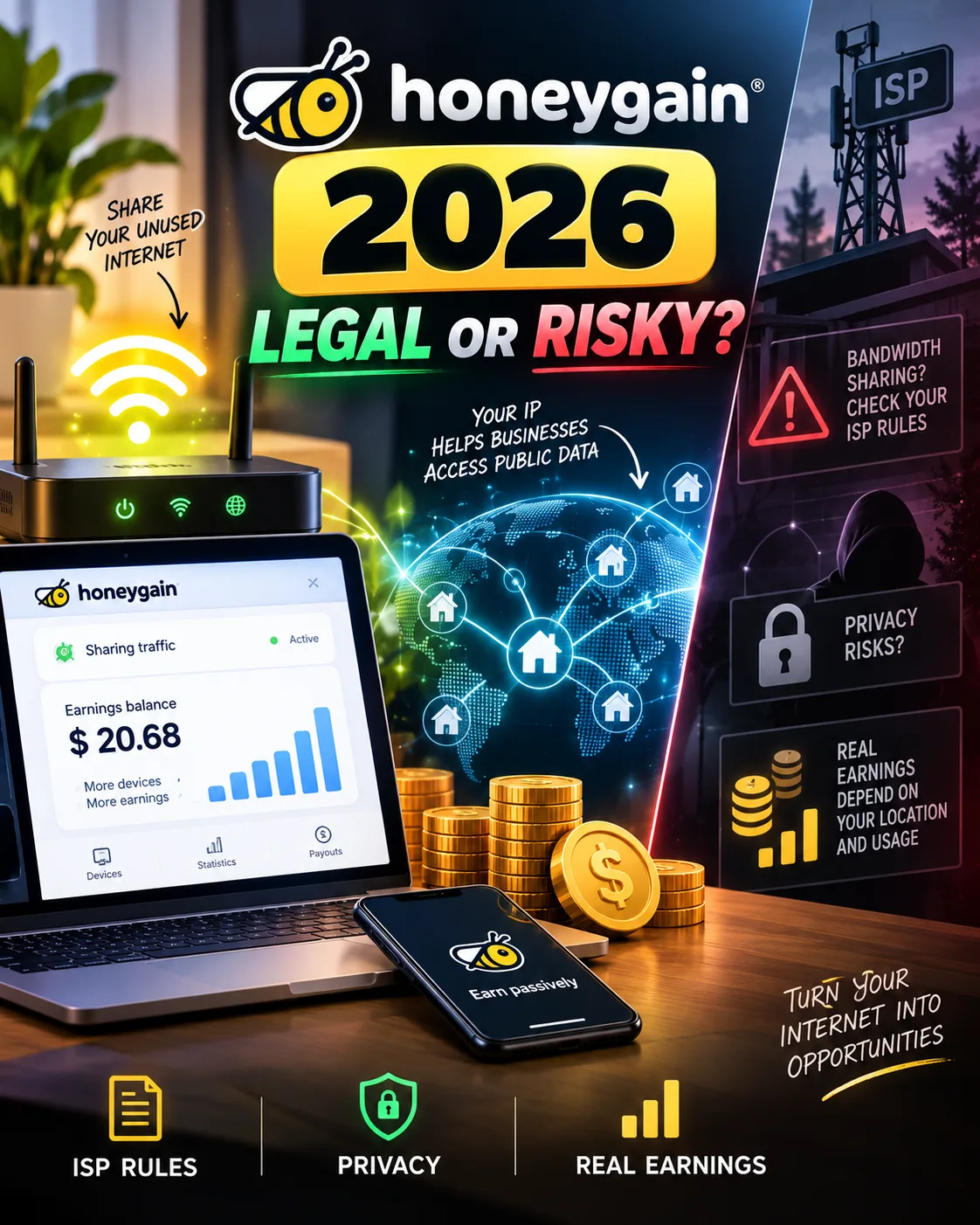 VERIFIED 2026
Quick answer
Honeygain is not illegal in the United States, United Kingdom, Canada or Australia. No law prohibits sharing your unused internet bandwidth with a proxy network, and Honeygain is a registered company with a real payout track record. But "legal" and "safe" are different questions.
Two practical risks matter most. First, most major ISPs — Comcast, AT&T, Verizon, BT, Sky, Telstra, Rogers — have acceptable use policies that prohibit reselling or commercially exploiting your connection to third parties. Bandwidth sharing sits in a grey zone that has never been tested in court, but it is not explicitly permitted. Second, your IP address can end up on blocklists, which affects your own ability to access services. This guide explains what Honeygain actually does, how the legal picture looks in English-speaking markets, what you realistically earn, and how to reduce the risks if you decide to use it.
What Honeygain actually does
Honeygain is a passive income app that pays you for sharing unused internet bandwidth. You install it on a PC, Mac, phone or Docker container, and it routes traffic from paying customers through your home IP address in the background. You are paid per gigabyte of traffic carried, not per hour.
The mechanism is a residential proxy network. Businesses buy access to real residential IP addresses to check prices across regions, verify ads, monitor brand mentions, run SEO audits, or gather data for AI training. Your connection becomes one of thousands of exit nodes in that network. You do not see who is using your IP or what they are doing with it.
That is the crucial point most reviews skip: it is not Honeygain itself routing traffic through your connection — it is Honeygain's customers. The company is the marketplace; the customers are the ones using your IP.
Is Honeygain legal?
The short answer: yes, using Honeygain is not against the law in any major English-speaking market. There is no statute in the US, UK, Canada or Australia that forbids sharing your own bandwidth. Honeygain is a legitimate company that pays users and has done so for years.
The longer answer involves three separate legal areas:
- Criminal law: Installing Honeygain is not a crime. You would only run into trouble if you knowingly facilitated illegal activity, which you cannot control or direct through the app.
- Contract law (ISP terms): The acceptable use policies of most ISPs prohibit "reselling" or "commercial use" of a residential connection by third parties. Whether bandwidth sharing falls under that definition is untested. No known case has resulted in a termination, but the risk is not zero.
- Privacy law: Your IP address is personal data under the UK GDPR, Canada's PIPEDA, and several US state laws (CCPA/CPRA in California, VCDPA in Virginia, CPA in Colorado). Honeygain collects this data and shares it with customers. Whether the consent flow fully complies with each regime is not independently verified.
This is not legal advice. If you plan to run Honeygain on a business connection or at scale, talk to a lawyer.
What your ISP actually says
Acceptable use policies vary, but the pattern is consistent: residential connections are for personal use, and using them to carry third-party traffic is either prohibited or not explicitly allowed. Here is what the major providers' terms imply in practice.
| Provider | Region | Relevant AUP language |
|---|---|---|
| Comcast / Xfinity | US | Prohibits reselling or commercial use of the service without a business agreement |
| AT&T | US | Restricts use to personal, non-commercial purposes |
| Verizon Fios | US | Prohibits resale of the service or its capacity |
| BT | UK | Prohibits reselling or sharing the connection with third parties |
| Sky Broadband | UK | Personal use only, no commercial exploitation |
| Rogers / Bell | Canada | Prohibits resale or commercial redistribution |
| Telstra | Australia | Personal use, no resale without consent |
In practice, no major ISP has publicly terminated a customer for running Honeygain. The enforcement risk is low, but the contractual exposure exists. It becomes more serious if you run Honeygain on a business plan, where commercial restrictions are stricter and more actively enforced.
What happens to your IP address
Your IP address is the product being sold. When a Honeygain customer makes a request through your connection, the destination website sees your IP, not theirs. That has two consequences.
First, if the customer uses your IP for scraping, spam, ad fraud, or other grey-area activity, your IP can end up on blocklists. Once blocked, you may find yourself solving more CAPTCHAs, getting locked out of Cloudflare-protected sites, or being denied access to services that were previously fine. This is not hypothetical — it is the most common complaint from long-term Honeygain users.
Second, if law enforcement traces an activity back to an IP address, your address is the one that appears. You would not be liable for the customer's actions — the traffic is not yours and you have no knowledge of it — but you would be the starting point of an investigation. This is rare, but it is the reason privacy advocates caution against residential proxy apps.
What you realistically earn in 2026
Honeygain pays in credits, where 1 credit is roughly 1 US dollar. According to published user reports and the platform's historical rates, the payout is about $1 per 10 GB of traffic carried. Most users with a single device on a typical home connection earn between $0.50 and $5 per month, depending on location, connection speed, and network demand in their region.
Users with multiple devices and a fast connection sometimes reach $5–$10 per month, but that is the exception, not the norm. The $20 payout threshold means many users wait several months before their first withdrawal.
| Setup | Realistic monthly earnings |
|---|---|
| 1 device, average connection | $0.50 – $2 |
| 1 device, fast fiber connection | $1 – $4 |
| Multiple devices, good connection, high-demand region | $3 – $8 |
| Business or multi-connection setup | Variable, often violates ISP terms |
These ranges are indicative and based on publicly reported user experiences. Actual earnings vary widely by month and are heavily dependent on how much demand Honeygain has in your area. If you see apps promising "$50 a month guaranteed," they are not describing Honeygain.
Payout: PayPal, JumpTask and the $20 threshold
Honeygain pays out once your balance reaches $20. There are two withdrawal methods:
- PayPal — direct to your PayPal account, usually processed within a few days.
- JumpTask — a crypto platform where you receive JMPT tokens.
Given realistic earnings of $1–$5 per month, the threshold means it often takes several months to reach your first payout. This is the single most under-reported fact about Honeygain in most reviews.
For users in the US, UK, Canada and Australia, PayPal is the straightforward option. There is no direct bank transfer or Interac option.
Alternatives worth comparing
Several apps run on the same bandwidth-sharing model. None is fundamentally safer, but the terms differ.
| App | Model | Payout | Realistic monthly earnings |
|---|---|---|---|
| Honeygain | Bandwidth per GB | PayPal, JumpTask ($20 threshold) | $0.50 – $5 |
| EarnApp | Bandwidth per time (since 2025) | PayPal | $1 – $8 |
| Repocket | Bandwidth per GB | PayPal, crypto | $0.50 – $4 |
| PacketStream | Bandwidth per GB | PayPal ($5 threshold) | $0.50 – $4 |
| Traffmonetizer | Bandwidth per GB | Crypto, PayPal | $0.50 – $3 |
EarnApp is owned by Bright Data, one of the largest residential proxy providers. Its model is more aggressive and its payouts are sometimes higher, but the privacy concerns are the same or greater. PacketStream has a lower payout threshold, which makes it easier to test without waiting months.
If your primary concern is privacy, none of these apps is a good fit. They all sell access to your IP.
How to reduce the risks
If you decide to run Honeygain anyway, these steps meaningfully reduce exposure:
- Use a separate device or network segment. Do not run Honeygain on the computer you use for banking, email, or work. A cheap dedicated mini-PC or a guest VLAN is enough.
- Do not use a business connection. Business plans have stricter commercial restrictions and are more actively monitored.
- Monitor your IP reputation. Sites like MxToolbox or WhatIsMyIP show whether your IP has been flagged on common blocklists.
- Read your ISP's AUP. Check whether your contract explicitly prohibits sharing with third parties. If it does, you are taking a contractual risk.
- Do not count the income. Treat it as a curiosity, not a budget line. At $1–$5 per month, it barely covers a coffee.
- Check your tax position. In the US, the IRS generally expects reporting of income above $400 from self-employment activities, though Honeygain earnings alone will rarely reach that. In the UK, HMRC has a £1,000 trading allowance before reporting kicks in. In Canada and Australia, similar thresholds apply. If you run several passive apps in parallel, keep a record.
FAQ
Is Honeygain illegal in the US or UK?
No. There is no law in the US, UK, Canada or Australia that prohibits sharing your own bandwidth. The risk is contractual, not criminal — your ISP's acceptable use policy may prohibit it, but no known case has led to enforcement against a residential customer.
Is Honeygain safe for my IP address?
Not entirely. Your IP is used by third parties for purposes you cannot see. If they engage in scraping or other grey-area activity, your IP can end up on blocklists, which affects your own access to some websites. This is the main practical risk.
Does Honeygain comply with GDPR?
Honeygain claims GDPR compliance and processes data based on user consent. Whether the consent flow fully meets UK GDPR or EU GDPR standards has not been independently verified. You can withdraw consent at any time by uninstalling the app, but the withdrawal applies going forward, not retroactively.
How much can I earn with Honeygain per month?
Realistically, $0.50 to $5 per month with a single device on a typical home connection. With multiple devices and a fast connection in a high-demand region, up to $8 is possible, but that is uncommon.
What is the payout threshold for Honeygain?
$20. Given realistic monthly earnings, it often takes several months to reach the first payout. Withdrawals are available via PayPal or JumpTask (crypto).
Can my ISP disconnect me for using Honeygain?
In theory, yes, if they classify it as a breach of their acceptable use policy. In practice, no major ISP in the US, UK, Canada or Australia has publicly done so. The risk is higher on business connections, which are more tightly regulated.
Is EarnApp better than Honeygain?
EarnApp pays more in some setups, but it is owned by Bright Data, one of the largest residential proxy operators, and raises similar privacy concerns. Neither app is a good primary income source. Both are best treated as small experiments.
The bottom line
Honeygain is legal, but it is not risk-free. You are selling access to your residential IP, and that has real consequences: potential ISP term violations, IP reputation damage, and the structural privacy issue of handing your address to third parties you cannot see. The earnings — $0.50 to $5 per month — are modest, and for many users the risks outweigh the benefit.
If you do try it, isolate it on a separate device, avoid business connections, monitor your IP reputation, and treat the income as a curiosity rather than a budget item. For readers who want to earn a modest amount without exposing their IP, task-based GPT sites like Freecash and GrabPoints are a better use of time — you will find detailed reviews and payout guides for both on LootHub.
Get the Ultimate GPT Insider Guide🚀
Learn how survey disqualifications work and proven ways to qualify for more studies. 100% Free.
LootHub.org
Recommended posts
Continue with these related reward guides.
 VERIFIED 2026
Is Honeygain Safe? Real Earnings, Legal Risks & Better Alternatives (2026)
 VERIFIED 2026
Honeygain vs EarnApp vs PacketStream vs Traffmonetizer vs Repocket: Real Passive Income Ranking (2026)
 VERIFIED 2026
Honeygain Content Delivery Explained 2026: How to Earn More Credits
 VERIFIED 2026
Honeygain Payment Methods 2026: PayPal, Crypto, Gift Cards & Fees Explained
 VERIFIED 2026