Is Freecash Safe? The 2026 Data Controversy, App Store Ban, and What Really Happened
FreeCash
 VERIFIED 2026
Quick answer
Freecash is a legitimate, operating business that has paid out over $300 million to more than 80 million users. But "legitimate" doesn't mean "complaint-free." The platform was removed from both the Apple App Store and Google Play in April 2026 over data harvesting allegations, and its BBB profile carries a "Pattern of Complaints" alert. Your data is the product being monetized — that's the business model. Whether that's an acceptable trade-off is a personal decision.
The Short Answer: Is Freecash Safe and Legit?
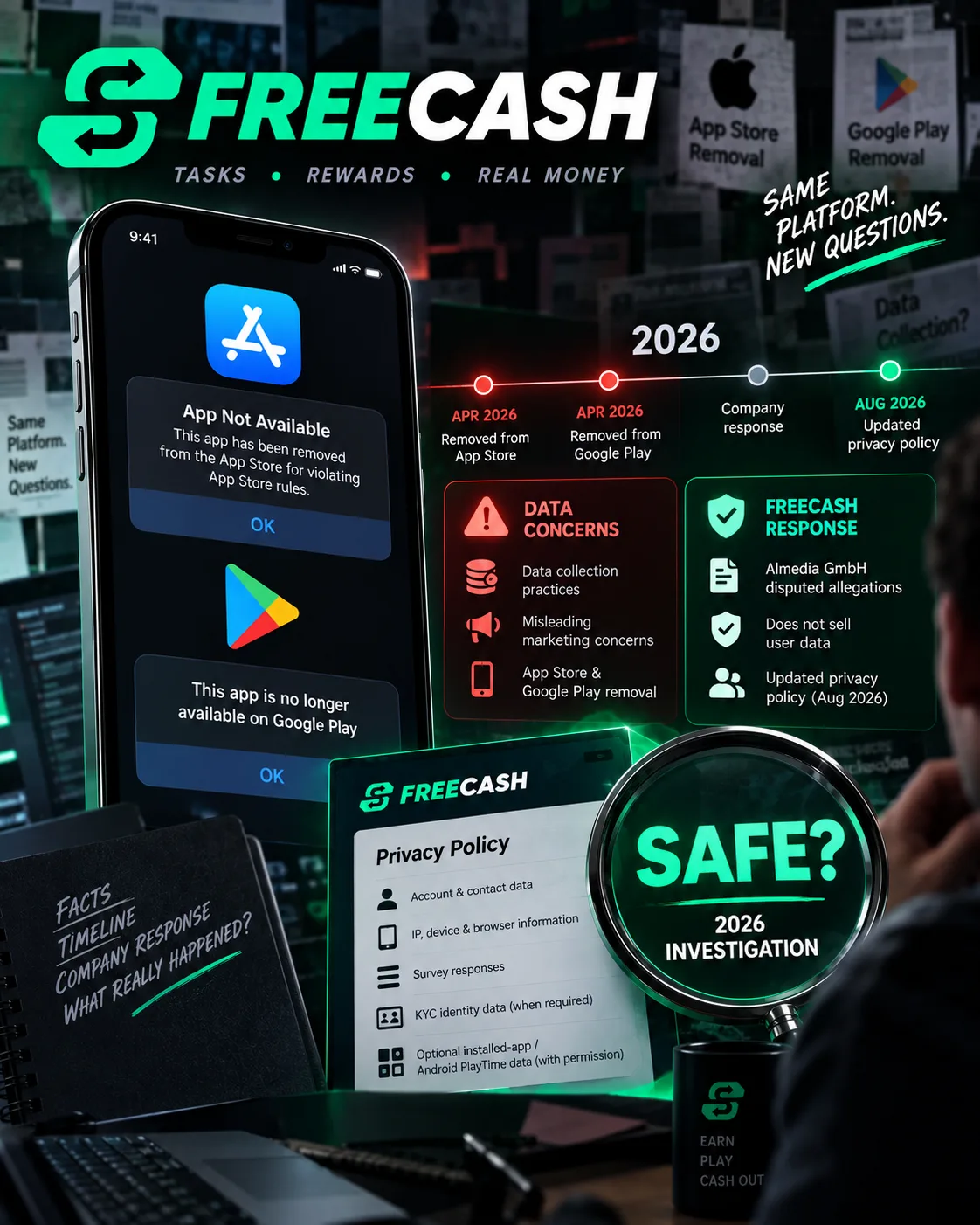
The 2026 Freecash Controversy: A Complete Timeline
The events that led to Freecash's removal from both major app stores unfolded over six months. Here's exactly what happened, based on court documents, press reports, and Freecash's own statements.
| Date | Event |
|---|---|
| January 26, 2026 | Wired publishes an investigation revealing Freecash's "get paid to scroll TikTok" ads were misleading. TikTok pulls some ads for violating financial misrepresentation rules. |
| January 2026 | Malwarebytes publishes a report alleging Freecash collects sensitive data including race, religion, sex life, sexual orientation, health, and biometrics. |
| February 2026 | Freecash downloads peak at nearly 6 million. The app reaches No. 2 on the US App Store overall chart. |
| April 14, 2026 | Apple removes Freecash from the iOS App Store without advance notice, citing violations of guidelines on scams and deceptive marketing. |
| April 16, 2026 | Freecash is also removed from Google Play. Almedia CEO Moritz Holländer publishes a statement calling the media coverage "inaccurate and misleading." |
| May 7, 2026 | Freecash is reinstated on Google Play following a "thorough review." |
| June 17, 2026 | Apple reinstates Freecash on the App Store. |
| August 2, 2026 | Freecash publishes a detailed response to the allegations, clarifying its data practices and announcing improvements to tracking and support. |
The key takeaway: Freecash was removed from both platforms for about three weeks on Google Play and two months on the App Store. Both platforms reinstated the app after reviews. Freecash was never permanently banned — but the removals were serious enough to trigger a company-wide response and a public relations crisis that continues to affect user trust.
What Data Does Freecash Actually Collect?
Freecash collects three categories of data: data you provide directly (profile information, survey answers), data collected automatically (device identifiers, IP address, usage patterns), and data collected through third-party tracking (in-app progress from gaming offers).
Freecash's own privacy policy states: "We process transaction and reward-related data in connection with your participation in offers, surveys, and other activities on the platform. This includes completed offers."
| Data Type | Purpose | Shared With |
|---|---|---|
| Name, email, country | Account creation and verification | Not shared |
| Survey responses (demographics, shopping habits) | Survey matching and market research | Survey partners (CPX, BitLabs, etc.) |
| In-app progress (game milestones) | Reward verification | Advertisers and Mobile Measurement Partners (MMPs) |
| Device identifiers, IP address | Fraud prevention, tracking | Advertisers, MMPs |
| ID document and selfie (via Veriff) | KYC verification before first withdrawal | Veriff (retained for up to 3 years) |
The Malwarebytes allegation that triggered the app store removals: The cybersecurity firm claimed Freecash's privacy policy "allows the automatic collection of highly sensitive information, including data about race, religion, sex life, sexual orientation, health, and biometrics".
Freecash's response: In its August 2026 statement, Freecash denied collecting sensitive data: "We do not collect sensitive data such as health, religion, or sexual orientation. In early 2026 we rewrote our privacy policy to remove broad legal language that was open to misinterpretation".
The company also stated: "Our revenue is our advertisers' marketing budgets, not your data. We never sell it".
What this means for you: Freecash does not sell your data in the traditional sense — it doesn't hand over your name and email to data brokers. But it does share anonymized behavioral data (your game progress, survey answers, device information) with advertisers and measurement partners. That's how the rewarded user acquisition model works. If you're uncomfortable with that trade-off, Freecash is not for you.
What Veriff Actually Stores (and for How Long)
Freecash uses Veriff for identity verification before your first withdrawal. Veriff stores your ID photos, selfie, and any video recordings captured during the verification process.
Freecash's help center confirms: "To ensure security and prevent fraudulent activity, Veriff securely stores the photos of your ID and selfie, as well as any video recordings captured during the verification process. This data is retained in compliance with GDPR & CCPA data retention policies".
How long is your data retained? Freecash states that verification data is deleted after 3 years. Veriff's own privacy notice states: "We store Personal Data only for as long as the retention of data is required by law".
Veriff's data practices: According to Freecash's documentation, Veriff "does not sell your data to anyone, and only shares it with us (Freecash)".
Why Accounts Get Restricted (and How to Avoid It)
Account restrictions are the most common complaint about Freecash — and the most misunderstood. Freecash restricts accounts for suspected fraud, not for requesting withdrawals.
Freecash states: "Freecash restricts accounts for suspected fraud, not for cashing out. Restricting legitimate accounts also wouldn't make sense, as those users would potentially stop completing offers".
The platform's own data shows that most users never experience issues: "Over the last 30 days, just 0.2% of users who completed an offer opened a support ticket. 99.8% never needed to contact us".
Common reasons for account restrictions:
- VPN use. Freecash prohibits VPNs. Using one can trigger a fraud flag.
- Multiple accounts. Creating more than one account to exploit referrals or bonuses is a violation of the Terms of Service.
- Ad blockers. Freecash prohibits ad-blocking extensions. They can interfere with tracking and trigger fraud detection.
- Suspicious offer completion patterns. Completing offers too quickly or using automated tools can flag your account.
- Chargebacks. If you make an in-app purchase, complete a milestone, and then request a refund from the app store, Freecash will deduct the corresponding reward from your balance.
What to do if your account is restricted:
- Contact support immediately through live chat. "Only human agents can process your request" for account issues.
- Provide a detailed explanation of your activity. "Sending an explanation does not guarantee that your withdrawal privileges will be restored. Approval is reviewed on a case-by-case basis."
- If you used a VPN, admit it. In my conversations with users who had restrictions lifted, honesty about VPN use was a factor in getting their accounts restored.
Trustpilot, BBB, and the "Pattern of Complaints"
Freecash has a mixed reputation across review platforms. Its Trustpilot rating sits at 3.2/5, but this includes a significant number of negative reviews from users who had accounts restricted or rewards not credited.
The Better Business Bureau flags Freecash's profile with a "Pattern of Complaints" alert, and the company is not BBB-accredited. Finder's review confirms: "BBB flags its profile with a 'Pattern of Complaints' alert, and it isn't accredited. The complaints and reviews BBB has published mostly describe accounts getting restricted and rewards not getting credited for higher-value milestones".
What the complaints actually say:
- Accounts getting frozen after reaching a significant balance
- Rewards not credited for high-value game milestones
- Support responses that feel templated or unhelpful
- Allegations of "fake chargebacks" deducting balances
Freecash's response to these complaints: The company acknowledges that 0.2% of users who complete offers open support tickets. It also acknowledges that some offers fail to track: "A small share of offers fails to track, and like any UA platform, we have historically been unable to stop this".
How Freecash Protects Your Data (and Where It Falls Short)
Freecash is subject to GDPR as a Berlin-based company (Almedia GmbH). It provides data deletion options, and its privacy policy outlines user rights. But the platform's data practices have been questioned by security researchers, and the app store removals in 2026 were a direct result of those concerns.
What Freecash does well:
- GDPR compliance. Freecash states: "Freecash is owned by Almedia GmbH, a Germany-based company. As such, we comply with the European General Data Protection Regulation (GDPR)".
- Data deletion. Users can request data deletion via live chat or email. "We will process your data deletion request within 30 days of receiving it, as required by GDPR".
- No data selling. Freecash states: "We do not sell this data or share it with third parties" beyond the necessary partners for platform operation.
- Veriff data protection. Veriff stores data "in compliance with GDPR & CCPA data retention policies" and does not sell user data.
Where Freecash falls short:
- The privacy policy language was broad enough to trigger scrutiny. Freecash admits: "In early 2026 we rewrote our privacy policy to remove broad legal language that was open to misinterpretation".
- Veriff stores your ID for up to 3 years. This is standard for KYC compliance, but it's a significant amount of personal data to hold.
- The app store removals happened. Apple and Google both determined that Freecash violated their policies — even if those violations were later resolved.
- Support quality is inconsistent. Multiple users report that support responses feel templated and unhelpful.
Freecash Safety: Pros and Cons
| Pros | Cons |
|---|---|
| Legitimate, operating business (Almedia GmbH, Berlin) | Removed from both app stores in April 2026 over data concerns |
| Paid out $300M+ to 80M+ users | BBB "Pattern of Complaints" alert |
| GDPR-compliant data practices | Veriff stores ID documents for up to 3 years |
| Data deletion available within 30 days | Privacy policy was previously broad enough to trigger scrutiny |
| Veriff does not sell user data | 99.8% of users never need support, but the 0.2% who do report poor experiences |
| Both app stores reinstated the app after review | Trustpilot rating of 3.2/5, with significant negative reviews |
Should You Trust Freecash with Your Data?
If you're comfortable with the trade-off — sharing behavioral data with advertisers in exchange for small monetary rewards — Freecash is a legitimate platform. If you're not comfortable with that trade-off, don't use it.
Freecash is not a scam. It pays real money, it has millions of satisfied users, and its data practices — while questionable in the past — have been reviewed and reinstated by both Apple and Google.
Freecash is not privacy-friendly. Your data is the product. The platform shares anonymized behavioral data with advertisers and measurement partners. Veriff stores your ID documents for up to 3 years. If you're privacy-conscious, this is not the platform for you.
The app store removals were a wake-up call. Apple and Google both determined that Freecash violated their policies. Even though the app was reinstated, the removals were a serious event that should inform your decision.
The bottom line: Use Freecash if you're comfortable with the data trade-off and you follow all the tracking rules. Don't use Freecash if you're not comfortable with third-party data sharing, or if you're prone to using VPNs or ad blockers (which will get your account flagged).
For privacy-conscious users: If you want to use Freecash but minimize data exposure, use a dedicated email address, avoid linking social accounts, and be aware that your ID documents will be stored by Veriff for up to 3 years if you withdraw.
For casual users: The $10 welcome bonus and low withdrawal minimum make Freecash a reasonable option for trying out GPT platforms. Just be aware that your data is being monetized, and follow all the rules to avoid account restrictions.
Frequently Asked Questions
Is Freecash a scam?
No. Freecash is operated by Almedia GmbH, a Berlin-based company that has paid out over $300 million to more than 80 million users. It is available on the App Store, Google Play, and the web.
What happened with Freecash and the app stores in 2026?
Apple removed Freecash from the iOS App Store on April 14, 2026, citing violations of guidelines on scams and deceptive marketing. Google Play removed the app on April 16, 2026. Both removals followed a Malwarebytes report alleging Freecash collected sensitive user data. Google Play reinstated the app on May 7, 2026, and Apple followed on June 17, 2026.
Platform information and limitations
Freecash states: "Our revenue is our advertisers' marketing budgets, not your data. We never sell it." The platform shares anonymized behavioral data (game progress, survey answers, device information) with advertisers and Mobile Measurement Partners to verify rewards and track offer completions. This is standard for rewarded user acquisition platforms.
What data does Veriff store?
Veriff stores photos of your ID and selfie, as well as any video recordings captured during the verification process. This data is retained for up to 3 years in compliance with GDPR and CCPA data retention policies. Veriff does not sell user data.
Platform information and limitations
Yes. You can request data deletion by contacting Freecash support via live chat or email. Include "Data Deletion Request" in the subject line and your Freecash User ID. Requests are processed within 30 days, as required by GDPR.
Why do accounts get restricted on Freecash?
Freecash restricts accounts for suspected fraud, not for requesting withdrawals. Common reasons include VPN use, multiple accounts, ad blockers, and suspicious offer completion patterns. Most restrictions are resolved after contacting support, though the outcome depends on the specific circumstances.
Is Freecash safe to use?
Freecash is safe in the sense that it is a legitimate business that pays real money. It is GDPR-compliant and does not sell user data. However, it is not privacy-friendly: your behavioral data is shared with advertisers, and Veriff stores your ID documents for up to 3 years if you withdraw. Whether that trade-off is acceptable is a personal decision.
Final Verdict: Is Freecash Safe?
Freecash is a legitimate platform with a real business model that pays real money. But the 2026 data controversy was serious, and the app store removals were a wake-up call for the entire rewarded user acquisition industry.
If you decide to use Freecash, follow these rules to protect yourself:
- Use a dedicated email address. Don't link your primary email or social accounts.
- Never use a VPN. Freecash prohibits them, and using one will get your account flagged.
- Disable ad blockers. They interfere with tracking and trigger fraud detection.
- Complete your own ID verification. Don't use someone else's documents — that's fraud.
- Keep records of your earnings. If you earn significant amounts, you'll need them for tax purposes.
- Request data deletion if you stop using the platform. It's your GDPR right.
My final assessment: Freecash is not a scam, but it's not a privacy-first platform either. It's a data-driven advertising business that shares a portion of its revenue with users. If you're comfortable with that model, the platform is safe to use. If you're not, there are other GPT sites with stricter data practices — though none with the same offer volume or payout potential.
For a complete breakdown of how to maximize your earnings on Freecash — including gaming offers, Burning Tasks, and the $10 welcome bonus — read our gaming offers guide. To understand how to withdraw your earnings and complete the Veriff KYC process, see our dedicated withdrawal guide.
Get the Ultimate GPT Insider Guide🚀
Learn how survey disqualifications work and proven ways to qualify for more studies. 100% Free.
LootHub.org
Recommended posts
Continue with these related reward guides.
 VERIFIED 2026
How to Automate GPT Site Tasks with AI (Without Getting Banned)
 VERIFIED 2026
Freecash Withdrawal Guide 2026: PayPal, SEPA, Crypto — Fees, KYC & Real Timelines
 VERIFIED 2026
JumpTask vs Freecash vs Swagbucks 2026: Which Microtask Platform Actually Pays Best?
 VERIFIED 2026
Best GPT Sites in Canada 2026: What Actually Works (Interac, PayPal, and More)
 VERIFIED 2026
GPT Site Account Banned? Causes, Appeals and How to Recover Your Balance
 VERIFIED 2026