PacketStream Account Banned? Why It Happens & How to Avoid It
PacketStream
 VERIFIED 2026
Quick answer
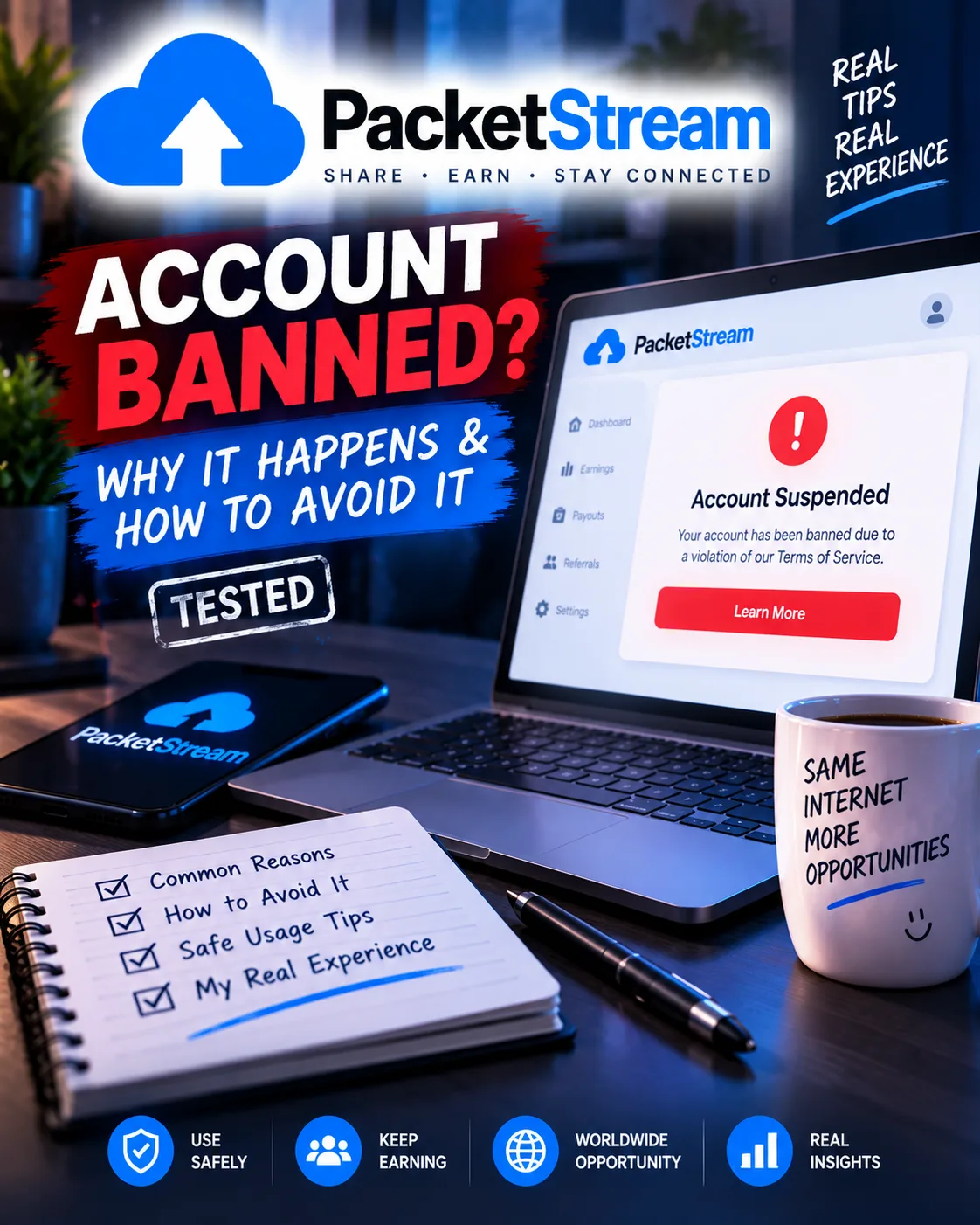
PacketStream bans or suspends accounts when it detects activity that violates its Terms of Service. The most common trigger is the "1 device per IP" rule — running the client on multiple devices or Docker instances behind the same IP address. Other triggers include VPN usage, suspicious traffic patterns, and earning "too much, too quickly." Once banned, your balance is locked and support rarely reverses the decision.
What Does a Banned PacketStream Account Actually Mean?
A banned PacketStream account means you cannot access your balance or withdraw your earnings. The client stops routing traffic, your dashboard may return an HTTP 500 error, and your credits are frozen. In most cases, the ban is permanent and the balance is lost.
Another user reported: "When you start making an actual passive income they will ban your account. Either their code auto bans you or they ban you for making money."
The platform's Terms of Service state: "You understand that your account and any Credits you have earned can be terminated or suspended at the sole discretion of PacketStream if PacketStream reasonably believes" that you have violated the rules. The key phrase is "sole discretion" — the platform reserves the right to ban without a detailed explanation.
What Triggers a PacketStream Ban?
The most common triggers for a PacketStream ban are: running multiple devices or Docker instances on the same IP address, using a VPN or proxy, suspicious traffic patterns, and violating the Acceptable Use Policy. The "1 device per IP" rule is the single most frequently cited reason.
Here's what each trigger means in practice:
| Trigger | What It Looks Like | How PacketStream Detects It |
|---|---|---|
| "1 device per IP" | Running the client on more than one device or Docker container behind the same IP | Device fingerprinting, IP address analysis, traffic pattern monitoring |
| VPN or proxy usage | Connecting through a VPN while running the client | IP address analysis, mismatch between IP location and expected residential profile |
| Suspicious traffic patterns | Abnormally high traffic volume in a short period | Behavioral analysis, traffic volume thresholds |
| AUP violations | Using the network for prohibited activities (DDoS, crypto mining, illegal content) | Traffic inspection, abuse reports |
The "1 device per IP" rule is the most commonly cited reason for bans. One user on TypicalScam reported: "I have PacketStream installed in 10 different ips and they ban me without any pay. They say 'PacketStream has a limit of 1 device/instance per IP address. Your account has been suspended due to selling bandwidth from multiple devices or Docker instances on the same IP address' which is a lie."
The Acceptable Use Policy explicitly prohibits "DDoS, VPN/Proxy, cryptocurrency mining, illegal content, and similar cases." The policy was updated in November 2025 with "more specific definitions" for these prohibited activities.
The Pattern: Banned at the Withdrawal Threshold
PacketStream has a documented pattern of banning accounts just as they reach the withdrawal threshold. Users consistently report being banned after accumulating $10–$20, often right after submitting a withdrawal request. Whether this is intentional or a flaw in the fraud detection system is unclear, but the pattern is too consistent to be coincidental.
Here are some of the user reports that illustrate this pattern:
- "Will block your account for no reason and prevent payout."
The $350 case is particularly striking. The user managed "a block of 128 residential IPs with fiber connections" and ran PacketStream on each of these IPs. They were banned and told to create a new account, but the $350 they had earned was not paid out.
The Appeal Process: What Actually Works
If your PacketStream account is banned, the only recourse is to email support@packetstream.io. Explain what happened, provide any evidence you have, and wait for a response. Response times are typically 12–24 hours, though some users report waiting up to 7 days. The appeal process is a single email exchange — there is no second-level appeal.
Based on documented user experiences and the platform's support-only appeal process, the recommended steps are:
- Email support@packetstream.io from the email address associated with your account. Do not create a new account. Do not use a different email address.
- Use a clear subject line. Something like: "Account suspension appeal — [your email] — [date]"
- Write a factual, non-defensive message. State what happened, acknowledge the suspension, and ask for clarification. Do not accuse the platform of theft or fraud. Template messages work against you.
- Attach any evidence you have. Screenshots of your dashboard, your earnings, and any relevant activity. If you believe the suspension was triggered by a VPN you were not using for PacketStream, say so and explain.
- Wait 12–24 hours for a response. Do not send multiple emails in the meantime. This can slow down your case.
- Respond promptly to any follow-up questions. If support asks for more information, provide it within 24 hours.
- Wait for the resolution. If support confirms the suspension was a mistake, your balance will be restored. If not, you will be told the decision is final.
Here's a template you can adapt:
One user on Pokmatic reported: "They took about 7 days to reply back to me. PacketStream support was honestly very frustrating." Another user noted: "PacketStream provides basic documentation including code samples, FAQ, and setup instructions, though there's no start guide or troubleshooting. The provider offers email-only support with average response times of 12-24 hours, though it claims 24/7 support."
What to Do If Your Appeal Is Denied
If PacketStream denies your appeal, your banned balance may be permanently lost. The platform does not offer a second-level appeal process. In this case, you can still use a new account to earn new credits — but the existing balance remains locked.
This is the harsh reality that many users discover too late. PacketStream's Terms of Service allow the platform to suspend balances for violations, and the support team's decision is generally final.
If your appeal is denied, your options are limited:
- Continue using the account for new earnings. If the suspension only affects your balance but not your ability to earn, you may be able to accumulate new credits. However, most banned accounts are fully locked.
- Accept the loss and move on. For balances under $20, this is often the most practical choice. The time spent fighting for reinstatement may exceed the value of the banned balance.
One user on Trustpilot wrote: "My advice make quick withdrawals and exit as soon as possible. Don't give a review till you actually surpass 100$. They will ask you to give them a good review. Don't give in to it till you get paid good money not just the minimum."
These amounts are significant, but the time and frustration of chasing them through support tickets often outweigh the recovery. A practical approach: if the banned balance is under $20, moving on may be more efficient. If it's over $50, it may be worth filing a complaint with the relevant consumer protection authority in your jurisdiction.
Your Rights by Jurisdiction: GDPR, CCPA, and Consumer Protection
PacketStream is operated by CreativeLab Inc., a company based in South Korea, which means the platform is subject to GDPR for users in the European Union. Users in California have rights under CCPA. Users in other jurisdictions may have consumer protection rights through their local authorities.
| Jurisdiction | Key Rights | How to Exercise Them |
|---|---|---|
| European Union (GDPR) | Right to access your data, right to rectification, right to erasure, right to data portability | Email support@packetstream.io with a formal data request. You can also file a complaint with your national Data Protection Authority (CNIL in France, DPA in Germany, etc.). |
| California (CCPA) | Right to know what data is collected, right to delete, right to opt out of sale | Email support@packetstream.io with a CCPA request. The platform must respond within 45 days. |
| United Kingdom (UK GDPR) | Similar to EU GDPR | Email support@packetstream.io. You can also complain to the Information Commissioner's Office (ICO). |
| Canada (PIPEDA) | Right to access and correct personal information | Email support@packetstream.io. You can also contact the Office of the Privacy Commissioner. |
| Australia (Privacy Act) | Right to access and correct personal information | Email support@packetstream.io. You can also contact the Office of the Australian Information Commissioner. |
For EU users, the GDPR gives you a powerful tool: the right to request a copy of all data PacketStream holds about you. If your account is banned, you can request a copy of your data and the reason for the ban. The platform must respond within 30 days.
According to PacketStream's privacy policy, the Data Protection Officer is Seongyun Ku. The company is registered in South Korea, but because it processes data of EU citizens, it must comply with GDPR. For users in France, the CNIL is the relevant authority. For users in Germany, it's the Bundesbeauftragte für den Datenschutz und die Informationsfreiheit (BfDI) or your state-level DPA.
It's worth noting that filing a data protection complaint is not the same as appealing a banned account. The data authority can force PacketStream to provide your data, but it cannot force the platform to reinstate your account. However, the threat of a data protection complaint sometimes motivates support teams to resolve cases more quickly.
How to Prevent a PacketStream Account Ban
Preventing a ban is easier than reversing one. The most important steps are: run only one device per IP address, disable your VPN before running the client, avoid suspicious traffic spikes, and follow the Acceptable Use Policy strictly.
The following prevention checklist is based on PacketStream's stated policies and documented user reports:
| Prevention Step | Why It Matters | How to Implement It |
|---|---|---|
| One device per IP | The #1 trigger for bans | Run the PacketStream client on only one device per IP address. Do not use Docker containers on the same IP. Do not run it on multiple devices behind the same router. |
| Disable VPN before logging in | VPN usage is prohibited and detectable | Turn off your VPN in your device settings, router settings, and browser extensions. Check your IP on whatismyipaddress.com before running the client. |
| Avoid traffic spikes | Abnormal traffic patterns trigger fraud detection | Let the client run naturally. Do not try to artificially increase traffic. |
| Follow the AUP | Violations lead to immediate bans | Do not use the network for DDoS, crypto mining, illegal content, or any prohibited activity. |
| Withdraw early and often | Reduces the balance at risk | Reach the $10 first withdrawal threshold, cash out, and then withdraw at $5 whenever possible. |
The most important step is the "1 device per IP" rule. This is not a guideline — it's a hard rule that PacketStream enforces aggressively. If you run the client on multiple devices behind the same router, you will be banned. If you run Docker containers on the same IP, you will be banned.
Another practical tip: if you use a VPN for privacy reasons on other apps, configure it to exclude PacketStream. Most VPN clients allow split tunneling, which lets you route only certain apps through the VPN while keeping others on your regular connection. But remember — PacketStream prohibits VPN usage entirely, so even split tunneling may be detected if the VPN is running on the same device.
PacketStream Availability and Ban Patterns by Region
PacketStream is available globally, but ban patterns vary by region. Users in the US, Germany, the UK, and Canada report the most stable accounts. Users in other markets report more frequent bans, possibly because the fraud detection system is more sensitive to traffic patterns in less-common regions.
| Region | Ban Frequency (User Reports) | Common Trigger | Notes |
|---|---|---|---|
| United States | Moderate | "1 device per IP" | Most reported bans occur at the withdrawal threshold |
| Germany | Low-Moderate | VPN usage | Strong market, stable accounts |
| United Kingdom | Moderate | Multiple devices | Mixed reports |
| France | Moderate | Traffic spikes | Thinner demand may trigger sensitivity |
| Canada | Moderate | "1 device per IP" | Fewer offers, but bans are less frequent |
| South Korea | Low | Rare | Home market for CreativeLab Inc. |
Users in France and the UK should be especially cautious about the "1 device per IP" rule. If you have multiple computers or a server running Docker, do not run PacketStream on more than one device per IP address. The platform enforces this rule aggressively.
FAQ: PacketStream Account Banned
Why was my PacketStream account banned?
The most common reason is violating the "1 device per IP" rule. Other triggers include VPN usage, multiple accounts, suspicious traffic patterns, and AUP violations. If your account is banned, you can appeal by emailing support@packetstream.io, but the decision is often final.
How do I appeal a banned PacketStream account?
Email support@packetstream.io from the email address associated with your account. Explain what happened, provide any evidence you have, and wait for a response. Response times are typically 12–24 hours, though some users report waiting up to 7 days. There is no second-level appeal.
How long does PacketStream support take to respond to an appeal?
Based on user reports, 12–24 hours for a first response. During peak periods, response times may be longer. One user reported waiting 7 days for a reply.
What should I include in my appeal email?
Include your account email, a clear subject line, a factual explanation of what happened, and any evidence you have (screenshots, IP address, device information). Do not be defensive or accusatory — template messages work against you.
What happens if my appeal is denied?
If your appeal is denied, your banned balance may be permanently lost. You can create a new account, but the existing balance remains locked. For small balances, it may be more practical to accept the loss and move on.
Can I create a second account if my first one is banned?
PacketStream's Terms of Service do not explicitly prohibit creating a new account after a ban, but the platform may detect it and ban the new account as well. One user reported that PacketStream invited them to make a new account but would not pay the $350 they had earned.
Platform information and limitations
If you are in the EU, GDPR gives you the right to access your data and the reason for the ban. You can file a complaint with your national Data Protection Authority. In California, CCPA gives you similar rights. In the UK, you can complain to the ICO.
How can I avoid getting banned?
Run only one device per IP address. Disable your VPN before logging in. Avoid traffic spikes. Follow the AUP strictly. Withdraw early and often to reduce the balance at risk.
Does PacketStream ban accounts in all countries?
Yes, but ban patterns vary by region. Users in the US, Germany, the UK, and Canada report the most stable accounts. Users in other markets report more frequent bans.
Are banned account earnings taxable?
In most jurisdictions, banned earnings are not considered taxable income until they are actually received. If your balance is permanently lost, you generally do not owe tax on it. Consult a tax professional if you are unsure.
Final Verdict: How to Protect Your PacketStream Account
PacketStream account bans are preventable, but the platform's fraud detection is aggressive. The most important step is following the "1 device per IP" rule — this single factor accounts for the majority of reported bans. If you do get banned, email support@packetstream.io with a clear, factual appeal and be patient. The process takes 12–24 hours for a first response.
The reality is that PacketStream bans accounts at the withdrawal threshold more often than most bandwidth-sharing platforms. This is a reported pattern, not a bug. The platform is legitimate, but its enforcement is strict. If you're going to use PacketStream, be aware of the risk and take steps to minimize it.
For a complete guide to cashing out on PacketStream — including the $10 first withdrawal threshold and the $5 minimum after that — see our PacketStream withdrawal guide. For a full breakdown of how much you can realistically earn, read our 90-day earning log. And for the full platform review, see our complete PacketStream review.
Get the Ultimate GPT Insider Guide🚀
Learn how survey disqualifications work and proven ways to qualify for more studies. 100% Free.
LootHub.org
Recommended posts
Continue with these related reward guides.
 VERIFIED 2026
PacketStream Withdrawal Guide 2026: PayPal, Fees & Minimum Payout
 VERIFIED 2026
Best Honeygain Alternatives 2026: EarnApp, PacketStream, Pawns.app & More Compared
 VERIFIED 2026
Honeygain vs EarnApp vs PacketStream vs Traffmonetizer vs Repocket: Real Passive Income Ranking (2026)
 VERIFIED 2026
How Much Can You Really Earn on PacketStream? A 90-Day Earning Analysis
 VERIFIED 2026
PacketStream Review 2026: Platform Analysis — Earnings and Limits
 VERIFIED 2026