Is PrizeRebel Safe? What the Platform Really Does With Your Data (2026)
PrizeRebel
 VERIFIED 2026
Quick answer
PrizeRebel is a legitimate platform that has been paying users since 2007. But "legitimate" does not automatically mean "risk-free" — and the main risk on PrizeRebel is not losing money. It's what happens to your personal data.
The platform states clearly that it does not sell or share your personal information for marketing purposes. That's true. But the privacy policy also explains that when you complete a survey, your demographic answers — age, gender, ethnicity, location, and market preferences — are shared with the market research companies that commissioned that survey. That's how the platform makes money, and it's the trade-off every user accepts when they sign up.
This is not a scam. It's the business model of GPT sites. But it's a trade-off that most reviews gloss over, and it's worth understanding before you invest hours of your time.
Is PrizeRebel Legitimate?
The platform has a Trustpilot rating of 3.8/5, according to Trustpilot's aggregate of user reviews. Many users report successful payouts, and independent reviewers consistently classify it as a legitimate GPT site.
But legitimacy is not the same as transparency. And transparency is where PrizeRebel — like most GPT platforms — falls short.
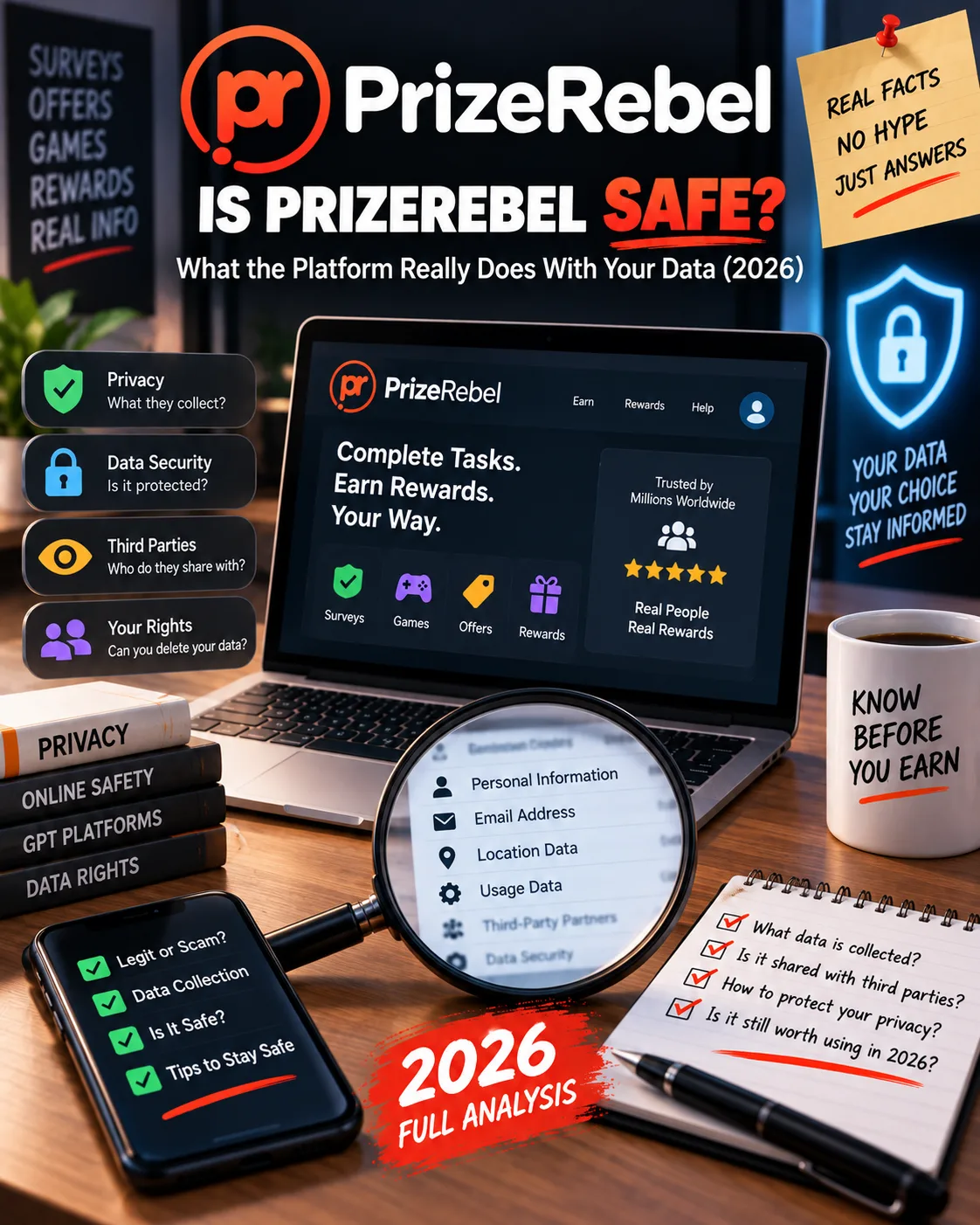
What PrizeRebel Actually Collects About You
Before you can earn meaningful amounts on PrizeRebel, you have to fill out a demographic profile. This is not optional — surveys are matched to your profile, and an incomplete profile means fewer surveys and more disqualifications.
- Basic demographics: Age, gender, ethnicity, race
- Location: Country, region, and sometimes postcode
- Household information: Employment status, education level, income bracket
- Market preferences: Brands you use, products you buy, media you consume
- Account data: Email address, password, and payment details (when you cash out)
PrizeRebel's privacy policy explicitly states that surveys and market research "involve users voluntarily providing information to a dynamic list of clients regarding their demographic information, which may include gender, race, ethnicity, age, sexual identity, and market preferences."
That's a lot of personal data. And while PrizeRebel itself doesn't sell it, the answers you provide in surveys are shared with the companies that commissioned those surveys.
How Your Data Is Actually Used
PrizeRebel's support documentation states that personal information is used for "two things only": sending account updates (reward confirmations, security notices) and shipping physical rewards if applicable. The platform also says it "will not sell or share your personal information for marketing purposes."
But the privacy policy tells a more complete story. When you complete a survey, you are "opting in" to sharing the information you provide with the client companies that requested the survey. You are also consenting to the collection, use, processing, maintenance, and transfer of that information to those clients.
In practice, this means:
- PrizeRebel uses your demographic data to match you with surveys that you're likely to qualify for. This benefits you — better matching means fewer disqualifications.
- The survey providers receive your answers — both the demographic profile information and the opinions you give in the survey itself. They use this data for market research.
- PrizeRebel does not sell your name, email, or payment details to third parties for marketing. This is the part of the policy that is genuinely protective.
The distinction matters: your survey answers and demographics are shared with research clients. Your identity and contact information are not sold.
What About Security Risks?
PrizeRebel does not appear to have suffered a major data breach, and the platform uses standard SSL encryption. But there are other security considerations that users should be aware of:
Scamadviser Trust Score: 39/100
According to Scamadviser, an automated website trust tool, PrizeRebel receives a trust score of 39/100 — which it classifies as "low." The main reason cited is that the website owner hides their identity on WHOIS using a paid privacy service. Scamadviser flags this as a common characteristic of scam sites. The tool also notes the presence of cryptocurrency services, which it flags as "high risk."
This score does not mean PrizeRebel is a scam. It means the platform's registration and payment infrastructure share characteristics with sites that have been used for scams. Scamadviser itself notes that DNSFilter considers the site safe and that the platform has existed for many years.
BBB Rating: C+
The Better Business Bureau (BBB) gives PrizeRebel a C+ rating due to "failure to respond to 1 complaint filed against business." The platform is not BBB-accredited. Other reviews have reported an F rating at different points, based on the same pattern of unanswered complaints.
Support Responsiveness
Multiple user reports describe slow or unresponsive support, especially regarding crediting issues and account suspensions. Published reviews indicate that some users report account bans after requesting payouts, though this pattern is not universal.
For a detailed look at payout problems and how to fix them, see our PrizeRebel payout troubleshooting guide.
KYC Verification: When PrizeRebel Asks for Your ID
Some users report being asked to provide a government-issued ID and a photo of themselves holding a handwritten note with the site's name before they can access their rewards. This is a KYC (Know Your Customer) verification — a standard anti-fraud measure used by financial platforms.
PrizeRebel does not require KYC for all users. It is typically triggered by:
- Unusually large redemptions
- Account activity that looks suspicious (VPN usage, multiple accounts from the same IP address or user)
- Discrepancies in the information you've provided
If you're asked for ID, you have a choice: comply or forfeit your earnings. There is no middle ground. The platform will not release rewards without verification if it has flagged your account.
This is a legitimate security measure, but it's also a significant privacy concession. If you're uncomfortable sharing ID with a GPT site, that's a reasonable position — and it's a reason some users avoid PrizeRebel entirely.
The Real Risk: Account Suspension After Payout Request
The most damaging privacy-related risk on PrizeRebel is not data misuse — it's account suspension immediately after requesting a payout. Multiple users have reported this pattern: they accumulate points, request a cashout, and then find their account suspended with no explanation and no recourse.
PrizeRebel's terms allow the platform to suspend accounts and forfeit pending rewards if it detects a violation of the Terms and Conditions. Common triggers include:
- Multiple accounts (the platform's terms generally allow only one account per user)
- VPN usage (detected as a security risk)
- Inconsistent survey answers or a high rate of "survey reversals"
- Ad blocker usage (which may interfere with tracking and lead to reversals)
When this happens, users lose not only their pending payout but also any accumulated points. The platform's terms state that banned accounts may forfeit all earnings.
This is not a data breach, but it is a privacy-adjacent risk: the platform controls your access to your own earnings, and if it decides you've violated the rules, there is no independent appeals process.
For a full breakdown of how this works and how to avoid it, see our PrizeRebel account ban guide.
How to Protect Yourself on PrizeRebel
If you decide to use PrizeRebel despite these risks, here's how to minimize your exposure:
- Use a dedicated email address. Don't use your primary email. Create a separate address specifically for GPT sites and other reward platforms.
- Use a unique password. Never reuse a password from another service. Use a password manager.
- Don't share sensitive information in free-response boxes. Surveys sometimes ask open-ended questions. Don't provide details that could identify you personally.
- Read the survey disclosure before opting in. If a survey asks for your email or contact details, a disclosure will explain how that data will be used. You can decline.
- Complete your profile honestly. Inconsistent answers trigger survey reversals, which can flag your account. Honesty here protects you as much as it protects the research.
- Never use a VPN. VPN usage is the fastest way to get your account flagged. Even a single VPN login can trigger a manual review.
- Keep only one account. Multiple accounts are grounds for permanent suspension.
- Cash out as soon as you hit the threshold. Don't accumulate large balances. If your account is suspended, you lose everything.
For a broader look at how to maximize earnings while staying safe, see our PrizeRebel earnings analysis and our payout methods guide.
Safer Alternatives to PrizeRebel
If you're uncomfortable with PrizeRebel's privacy practices, here are platforms with different trade-offs:
- Prolific — Academic research platform. Requires only basic demographic information, pays significantly more per hour (£5–£12+), and does not use the same aggressive data-sharing model. It is not available in all countries.
- UserTesting — Website and app testing. Pays $10 per 20-minute test. Requires screen recording and voice commentary, which is more invasive in some ways, but the data use is clearly disclosed and limited to the specific test.
- Freecash — A GPT site with a stronger Trustpilot rating (4.8/5). It has its own privacy policy and data-sharing practices, but it has a better public reputation than PrizeRebel.
For a direct comparison of PrizeRebel and Freecash, see our PrizeRebel vs Freecash comparison.
Frequently Asked Questions
Does PrizeRebel sell your data?
PrizeRebel states that it does not sell or share your personal information for marketing purposes. However, your survey answers and demographic information are shared with the market research companies that commission surveys. Your name, email, and payment details are not sold.
Is PrizeRebel safe to use?
PrizeRebel is legitimate and pays, but it carries privacy risks. Your demographic data is shared with research clients, and the platform has a low Scamadviser trust score (39/100) due to WHOIS privacy and crypto-related flags. Account suspension after payout request is also a reported risk.
Why does PrizeRebel ask for my ID?
PrizeRebel requests ID verification (KYC) when it flags an account for unusual activity, such as large redemptions, VPN usage, or multiple accounts from the same user or IP address. This is a standard anti-fraud measure. You can decline, but you will not be able to access your rewards.
Platform information and limitations
PrizeRebel's privacy policy does not clearly address what happens to user data in the event of a sale or acquisition. This is a common gap in GPT site policies. If data ownership is a concern for you, this is a reason to avoid the platform.
Can I use PrizeRebel without filling out the demographic profile?
No. The demographic profile is required to match you with surveys. Without it, you will see very few surveys and will be disqualified from most of the ones you attempt. The profile is the price of admission.
Is PrizeRebel GDPR-compliant?
PrizeRebel's privacy policy references data controller obligations and user rights, which suggests an attempt at GDPR alignment. However, the platform is US-based, and its primary compliance framework is not clearly stated. EU users have the right to request data access and deletion, but enforcement may be difficult for a US-based platform.
What is the safest way to use PrizeRebel?
Use a dedicated email address, a unique password, complete your profile honestly, never use a VPN, keep one account, and cash out as soon as you reach the threshold. Do not accumulate large balances, and do not share sensitive personal information in free-response survey boxes.
Get the Ultimate GPT Insider Guide🚀
Learn how survey disqualifications work and proven ways to qualify for more studies. 100% Free.
LootHub.org
Recommended posts
Continue with these related reward guides.
 VERIFIED 2026
PrizeRebel Payout Methods 2026: PayPal, Venmo, Crypto or Gift Card — Which Pays Best?
 VERIFIED 2026
PrizeRebel Account Banned? Here's What to Do (2026 Guide)
 VERIFIED 2026
PrizeRebel Payout Not Received? Step-by-Step Fix (2026)
 VERIFIED 2026
PrizeRebel for International Users: What Actually Works Outside US, UK, CA, AU (2026)
 VERIFIED 2026