Taxes on Extra Digital Income in Germany 2026: What You Must Declare
FreeCash
 VERIFIED 2026
Quick answer
If you earn extra income from GPT sites, surveys, cashback apps, or any online activity in Germany, you must declare it to the tax office. There is no blanket exemption for small amounts. The critical threshold is the Grundfreibetrag (basic tax-free allowance), which rises to €12,348 for 2026. If your total annual income — including your main job — stays below that amount, you pay no income tax. If it exceeds it, every additional euro is taxable at your personal rate.
Most people earning from GPT sites already have a full-time or part-time job. Their salary alone typically exceeds €12,348, which means their extra digital income is almost always taxable — even if it's just €50 for the year. This guide explains the rules in plain language, what changed for 2026, and why the tax office is increasingly aware of online earnings.
Is There a Tax-Free Amount for Side Income in Germany?
No. Germany has no blanket "Bagatellgrenze" (triviality threshold) below which side income is automatically tax-free. This is a widespread misconception, and it leads to problems when the tax office comes asking.
The German tax system works differently. Every euro you earn is added to your total annual income. The Grundfreibetrag is then deducted. Only the amount above that threshold is taxed.
For 2026, the Grundfreibetrag is €12,348 for single taxpayers and €24,696 for married couples filing jointly. This means:
- If your total income (salary + side gigs + GPT earnings) is below €12,348, you pay no income tax.
- If your total income is above €12,348, your side income is taxed at your personal marginal rate — the rate that applies to the last euro you earn.
In practice, almost everyone with a full-time job earns more than €12,348. Their salary alone consumes the entire tax-free allowance. Any additional income from GPT sites is therefore fully taxable from the first euro.
The 2026 Tax-Free Allowance: What Changed
| Year | Grundfreibetrag (Single) | Grundfreibetrag (Married, Joint) |
|---|---|---|
| 2024 | €11,604 | €23,208 |
| 2025 | €12,096 | €24,192 |
| 2026 | €12,348 | €24,696 |
The allowance increased by €252 for 2026, following a €492 increase the previous year. This is part of a broader adjustment to keep the tax-free minimum subsistence level in line with inflation. For GPT site earners, the practical impact is minimal — if you have a regular job, your allowance is already used up.
How Much Tax Will You Actually Pay on GPT Earnings?
Side income is not taxed separately. It's added to your total income and taxed at your personal marginal rate. That's the rate applied to the highest portion of your income.
Here's a simplified example. Suppose you earn €30,000 per year from your main job and €1,000 from GPT sites:
- Your total income is €31,000.
- Your marginal tax rate at €30,000 is roughly 30–35%, depending on your tax class.
- The €1,000 from GPT sites would be taxed at approximately 30–35%, meaning you owe roughly €300–€350 in income tax.
- Solidarity surcharge and church tax may add a small amount on top.
This sounds significant, but remember: you still keep €650–€700 of the €1,000. And you can deduct business expenses before calculating the taxable amount.
What Counts as a Business Expense?
If you're earning through digital platforms, you can deduct expenses directly related to that activity. Common deductions include:
- Internet costs (proportional to usage)
- Depreciation on your phone, laptop, or tablet
- Software subscriptions used for earning
- Banking fees on withdrawals
- A portion of your electricity if you work from home
The tax office doesn't require receipts for every cent, but you should keep documentation. If you're audited, you'll need to show that the expenses were genuinely for your earning activity.
Hobby or Commercial Activity? The Legal Distinction
German tax law distinguishes between a hobby (Liebhaberei) and a commercial activity (gewerbliche Tätigkeit). The classification determines your tax obligations.
When It's a Hobby
A hobby is an activity pursued for personal enjoyment without the intention of making a sustained profit. Key indicators:
- No profit motive — you'd do it even if it paid nothing
- Occasional or irregular activity
- No business-like organisation (no website, no advertising, no separate accounts)
- Objective assessment shows no realistic chance of long-term profit
Income from a genuine hobby is tax-free. But there's a catch: you also can't deduct losses.
When It Becomes Commercial
An activity crosses into commercial territory when it meets the criteria under § 15 (2) EStG:
- Profit motive — you're doing it to make money, not just for fun
- Sustainability — you engage in the activity regularly and with intent to repeat
- Participation in economic life — you're offering something to a market
For GPT site users, the classification depends on scale and regularity. Someone who completes a few surveys occasionally is likely a hobbyist. Someone who logs in daily, rotates between platforms, and treats earnings as a predictable income stream is more likely to be classified as commercial.
The tax office assesses each case individually. If you're unsure, consult a tax advisor. Getting this wrong can be expensive.
What Is the Platform Tax Transparency Act (PStTG)?
Since January 2023, Germany has implemented the Plattformen-Steuertransparenzgesetz (PStTG), which transposes the EU's DAC7 Directive into German law. This law requires digital platform operators to report certain user data directly to the tax authorities.
What Platforms Must Report
Under the PStTG, platform operators must report:
- The user's name and address
- Tax identification number
- Total consideration paid to the user
- Number of relevant activities
- Any fees or commissions deducted
This data is transmitted to the Bundeszentralamt für Steuern (BZSt) — the Federal Central Tax Office — and automatically exchanged with other EU member states. For the 2025 reporting period, platform operators were required to submit their reports by 2 February 2026.
Does This Apply to GPT Sites?
Yes, if the GPT site qualifies as a "platform operator" under the PStTG and the user is a "reportable person." The law applies to platforms that facilitate relevant activities — including the sale of goods, personal services, and rental of property.
Whether a specific GPT site falls under the reporting obligation depends on its structure and where it's registered. But the trend is clear: platforms are increasingly required to share data with tax authorities. The assumption that "the Finanzamt doesn't know" is no longer safe.
How the Finanzamt Finds Out About Your Online Earnings
There are several ways the tax office can become aware of your GPT site earnings, even if you don't declare them.
- Platform reporting under PStTG. As described above, platform operators report user data directly to the BZSt.
- Payment service providers. PayPal, banks, and other payment processors are subject to reporting obligations for certain transaction types.
- Bank account reviews. Regular incoming payments — even small ones — can trigger questions during a tax audit.
- Inconsistencies in your tax return. If your lifestyle doesn't match your declared income, or if you declare unusually low earnings while showing significant spending, the tax office may investigate.
- Voluntary disclosure by third parties. In disputes or legal proceedings, platform data may be requested.
The "ignorance defence" — claiming you didn't know you had to declare — does not hold up. Tax authorities expect you to be aware of your obligations.
VAT and the Kleinunternehmerregelung
If your GPT site earnings cross the threshold from hobby to commercial activity, you may also need to consider VAT (Umsatzsteuer).
Germany's Kleinunternehmerregelung (§ 19 UStG) exempts small businesses from charging VAT, provided their turnover stays below certain limits. As of 2025, the thresholds are:
- €25,000 turnover in the previous calendar year
- €100,000 turnover in the current calendar year
If you exceed the €100,000 threshold mid-year, the exemption ends immediately and you must charge VAT from that point forward.
For most GPT site users, these thresholds are far out of reach. But if you're earning significant amounts from multiple platforms, or if you're also selling digital products or services, it's worth understanding where you stand.
Practical Steps to Stay Compliant
Here's what you should do if you're earning from GPT sites or other digital side activities in Germany.
- Track your earnings. Keep a simple spreadsheet with dates, platforms, amounts, and payout methods. Even if you don't need it for a tax return this year, you'll want it if the tax office asks questions.
- Separate your accounts. Use a dedicated bank account or payment method for GPT earnings. This makes it easier to track income and expenses.
- Set aside tax reserves. If you're earning regularly, set aside 25–35% of your net earnings for potential tax liabilities.
- Declare your income. If you file a tax return (either voluntarily or because you're required to), include your GPT earnings. The tax office expects it, and undeclared income can lead to penalties.
- Consult a tax advisor if unsure. The hobby-vs-commercial distinction is not always clear. A Steuerberater can assess your specific situation and help you avoid mistakes.
- Know the deadlines. For the 2025 tax year, the standard deadline for self-prepared returns is 31 July 2026. If you use a tax advisor, the deadline extends to 28 February 2027.
Frequently Asked Questions
Do I need to declare €50 from a GPT site in Germany?
Technically, yes — if you're required to file a tax return. There's no minimum threshold below which side income is automatically exempt. In practice, the tax office isn't pursuing people over €50. But the legal obligation exists, and if you're already filing a return, you should include it.
What is the tax-free amount for side income in Germany?
There is no specific tax-free amount for side income. The only relevant threshold is the Grundfreibetrag — €12,348 for singles and €24,696 for married couples in 2026. If your total income is below this, you pay no income tax. If it's above, side income is taxable from the first euro.
Does the Finanzamt know about my GPT site earnings?
Increasingly, yes. The PStTG requires platform operators to report user data directly to the BZSt. Payment service providers also have reporting obligations. The assumption that online earnings are invisible is outdated and risky.
When does a hobby become a commercial activity?
When you pursue the activity with profit intent, on a regular basis, and with a business-like organisation. The tax office assesses each case individually. If you're earning consistently and treating the activity as a source of income, you're likely on the commercial side of the line.
What happens if I don't declare my GPT earnings?
If the tax office discovers undeclared income, you may face back taxes plus interest and potentially penalties. In serious cases of tax evasion, criminal prosecution is possible. The risk increases with the amount involved and the duration of non-declaration.
Do I need to charge VAT on my GPT earnings?
Most GPT site users stay far below the Kleinunternehmerregelung thresholds (€25,000 previous year / €100,000 current year) and are therefore exempt from charging VAT. If you approach those thresholds, consult a tax advisor.
Bottom Line
If you're earning extra income from GPT sites, surveys, or cashback apps in Germany, you're legally required to declare it. There's no small-amount exemption, and the tax office is increasingly well-informed about digital earnings through the PStTG.
The practical approach is straightforward: track your earnings, set aside a tax reserve, declare your income, and consult a tax advisor if you're unsure whether your activity is a hobby or a commercial enterprise. The rules aren't complicated, but ignoring them is.
Get the Ultimate GPT Insider Guide🚀
Learn how survey disqualifications work and proven ways to qualify for more studies. 100% Free.
LootHub.org
Recommended posts
Continue with these related reward guides.
 VERIFIED 2026
Best GPT Sites in Germany 2026: Honest Guide for Serious Earners
 VERIFIED 2026
Idle-Empire Germany 2026: Legit? SEPA Payouts, GDPR & Real Earnings
 VERIFIED 2026
How to Withdraw via SEPA from GPT Sites: Full Guide for Germany & France
 VERIFIED 2026
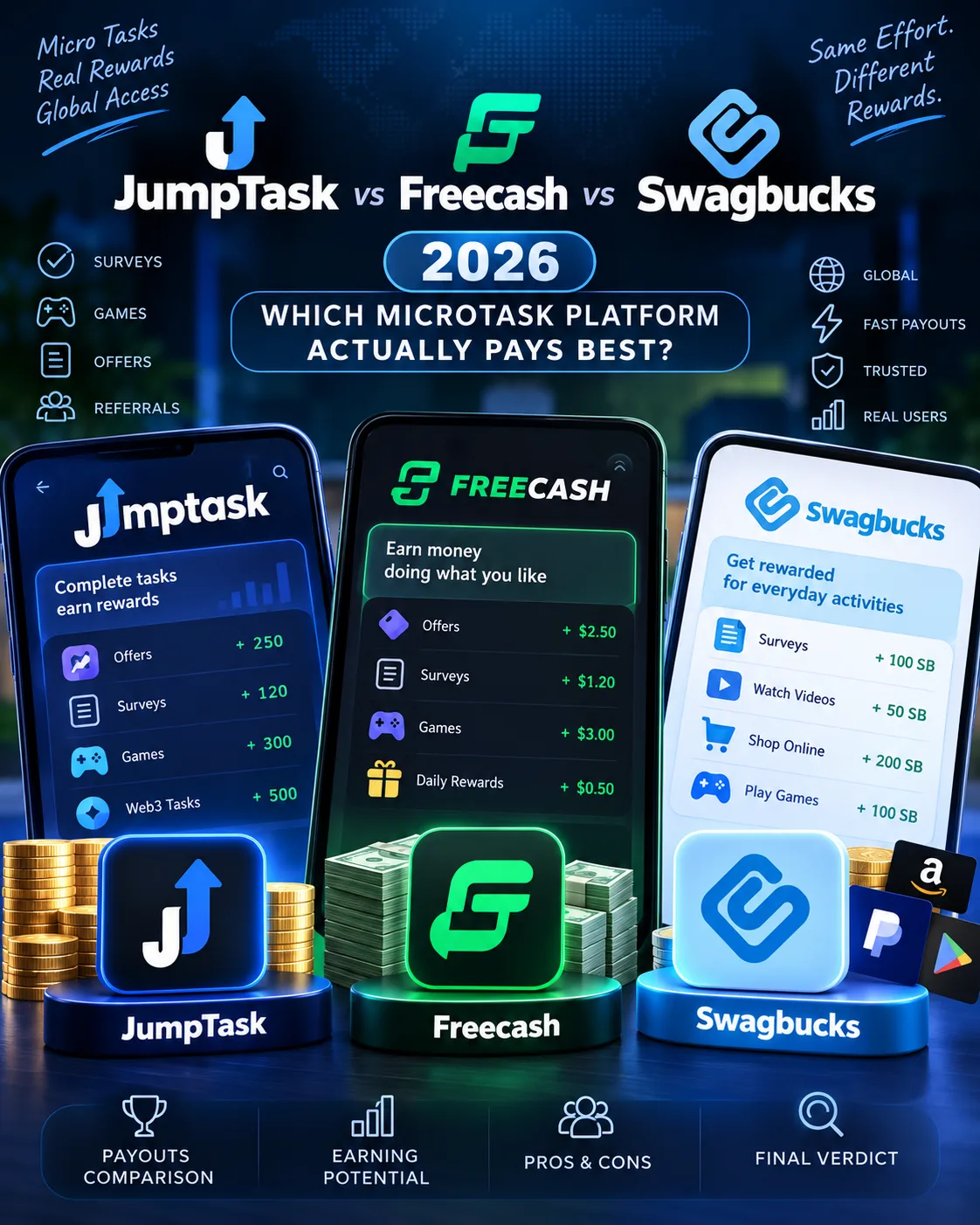
JumpTask vs Freecash vs Swagbucks 2026: Which Microtask Platform Actually Pays Best?
 VERIFIED 2026
Crypto Payouts on GPT Sites 2026: Volatility, Fees & Tax Traps to Know
 VERIFIED 2026