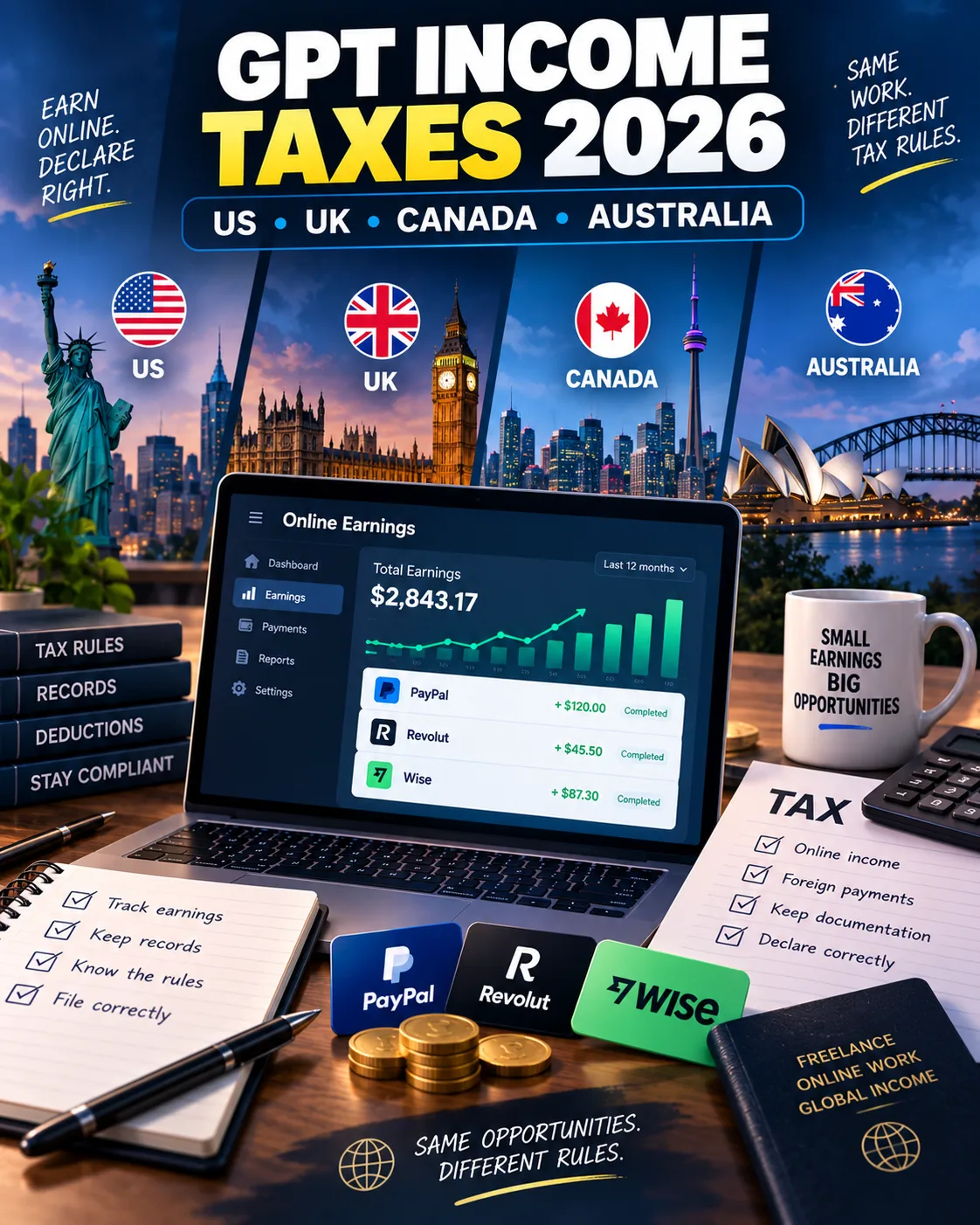
Taxes on GPT Site Income 2026: What You Must Declare in the US, UK, Canada & Australia
FreeCash
 VERIFIED 2026
Quick answer
Most users earning a few dollars a month from GPT sites will not owe tax and are not required to file, because the amounts fall below the reporting thresholds in their country. But "below the threshold" is different from "not taxable," and the threshold is lower than many people assume.
This guide explains how each of the four main English-speaking tax authorities treats income from GPT sites, survey platforms, cashback apps, and bandwidth-sharing apps. It covers the hobby-versus-business distinction, the practical thresholds, and the record-keeping that makes filing painless if the amounts ever become meaningful. This is not tax advice — for your own situation, consult a qualified accountant or the relevant tax authority.
What counts as taxable GPT income?
GPT sites, survey platforms, cashback apps and passive income apps generate several types of reward. From a tax perspective, they broadly fall into three categories:
- Cash rewards — PayPal payouts, bank transfers, crypto. These are the clearest form of income and are treated as taxable earnings in most jurisdictions once thresholds are exceeded.
- Gift cards and vouchers — Amazon, Visa, iTunes, retail brands. These have a determinable cash value and are generally treated the same as cash for tax purposes, even though they are not cash in your hand.
- In-kind rewards and points — platform-specific currencies, entries into sweepstakes, or free products received in exchange for reviews. These are often treated differently and, in most jurisdictions, only become taxable when converted into cash or something with a clear monetary value.
The important principle is that reward apps do not pay you in a special category. Once you receive something with a quantifiable value, that value is treated as income under normal rules — whether it arrives via PayPal or as an Amazon gift card.
How much can you earn before it matters?
Practical reporting thresholds in the four main markets:
| Country | Reporting threshold / rule | Notes |
|---|---|---|
| United States | $400 net self-employment income | Below $400, no self-employment tax. Hobby income rules differ |
| United Kingdom | £1,000 gross trading income | Trading allowance — no reporting needed below this |
| Canada | All income in principle | Small amounts often go unreported, but obligation exists |
| Australia | All income in principle | Hobby income may not be assessable; business income is |
These are indicative thresholds, not a substitute for professional advice. Personal circumstances, other income sources, and country-specific rules can change the practical picture considerably.
United States
The US tax treatment of GPT income depends on one thing above all: whether the activity is a hobby or a business. The IRS draws this line based on intent — whether you are doing it for profit, with regularity and a business-like approach, or as an occasional pastime.
If it is a hobby
Since the 2017 Tax Cuts and Jobs Act, hobby income is reported as "other income" on Schedule 1 of your Form 1040, and hobby expenses are no longer deductible. Critically, hobby income is not subject to self-employment tax, which is the 15.3% that covers Social Security and Medicare.
The reported amount is the income actually received — cash, and the fair market value of gift cards. Platform-specific points that have not been converted to cash are generally not reported until redemption.
If it is a business
If the IRS determines that you are running a business — for example, if you are treating the GPT activity as a regular income-generating enterprise — then the income is subject to both ordinary income tax and self-employment tax, and you can deduct ordinary and necessary business expenses.
Platform reporting
Payment processors in the US issue Form 1099-K or 1099-MISC once payments exceed certain thresholds. Third-party settlement organizations have shifted their reporting thresholds in recent years, and PayPal and similar services will report at a level determined by current IRS rules. Even if you do not receive a form, you are still responsible for reporting income that meets the thresholds.
United Kingdom
HMRC's approach for small side incomes is simpler and friendlier than the US system. The trading allowance allows you to earn up to £1,000 gross per tax year from trading activities — including GPT sites, survey panels, cashback apps and freelance-style micro-work — without needing to report it or register for Self Assessment.
Below £1,000, you generally do nothing. Above £1,000, you have two options:
- Deduct actual expenses from your trading income and pay tax on the profit.
- Use the £1,000 trading allowance as an alternative to actual expenses, and pay tax on the amount above that.
If your total income — including salary, pension and any other sources — exceeds the personal allowance, you may need to register for Self Assessment once trading income goes above £1,000, even if the tax due ends up being small.
One practical point: the £1,000 allowance applies to gross trading income, not net. If you earned £1,200 from GPT sites and had £300 in associated costs, you have still exceeded the allowance and would need to determine whether any tax is actually due.
Canada
The Canada Revenue Agency expects all income to be reported, including income from GPT sites, survey platforms and cashback apps. There is no formal de minimis exemption for personal income in the way the UK has one.
In practice, small amounts from reward apps are rarely pursued and most taxpayers do not report them. But the obligation exists, and if the amounts grow — for example through a bandwidth-sharing app running on multiple devices, or a regular GPT income stream — the CRA could reasonably expect it to appear on your return.
How you report it depends on the nature of the activity:
- Hobby income is typically reported as "other income" on line 13000 of the T1 return. Expenses are generally not deductible against hobby income.
- Business income is reported on form T2125 and allows for the deduction of expenses. If your combined taxable revenue across all sources exceeds the small supplier threshold, you may also need to register for and collect GST/HST.
For users in Quebec, the provincial return is filed separately with Revenu Québec, and the rules broadly mirror the federal ones with some differences in treatment of small amounts.
Australia
The Australian Taxation Office distinguishes between a hobby and a business. If your GPT activity is a hobby — done occasionally, without a business-like structure, and not with a clear intent to make a profit — the income is generally not assessable, and you do not need to declare it.
If the ATO considers it a business, the income becomes assessable and you can claim deductions for related expenses, but you may also need to register for an ABN and account for GST depending on turnover.
The dividing line is similar to other jurisdictions and depends on factors like regularity, organisation, and whether you treat the activity as a serious income-generating enterprise or a casual pastime. For most users earning $20 to $100 per month across reward apps, the activity falls squarely within hobby territory.
Unlike the UK, Australia does not have a formal trading allowance. If your GPT activity is deemed a business, all income above the tax-free threshold is assessable.
The hobby-versus-business distinction
Across all four jurisdictions, the practical tax question is the same: is this a hobby or a business? The specific tests differ, but the underlying factors are consistent:
| Factor | Points toward hobby | Points toward business |
|---|---|---|
| Frequency | Occasional, irregular | Regular, scheduled |
| Scale | One or two platforms | Multiple platforms, systematic approach |
| Records | No tracking | Spreadsheets, receipts, expense tracking |
| Intent | Supplementary, casual | Profit motive, growth-oriented |
| Time invested | A few hours per month | Several hours per week |
| Marketing / promotion | None | Referral links, content creation, community involvement |
If most of your answers land in the left column, the activity is a hobby and is likely not taxable in the UK or Australia, and not subject to self-employment tax in the US. If most land in the right column, treat the income as business income and consider consulting a professional.
Practical record keeping
Even if your current earnings are trivial, a small amount of bookkeeping now will save significant effort later. The minimum useful record is:
- A running total of earnings per platform. A simple spreadsheet with columns for date, platform, amount received, and currency is enough.
- Screenshots or PDFs of payout confirmations. These prove the amount and the date when questioned.
- Gift card redemptions converted to a fair market value. If you redeem an Amazon gift card worth $10, record $10, not "one gift card."
- A note of the method used for each payout. PayPal, bank transfer, crypto — this matters if any of the destinations has its own reporting requirements.
- Crypto conversions. If a platform pays in crypto, the value at the time of receipt is what matters. Further gains or losses are a separate tax event in most jurisdictions.
If you use several reward platforms — Swagbucks, Freecash, GrabPoints, ySense, Honeygain, and others — keep them in the same spreadsheet. The total is what matters, not each individual balance.
What if you never receive a tax form?
In the US, UK, Canada and Australia, the absence of a tax form does not mean the income is not reportable. Payment processors issue forms above certain thresholds, but the underlying obligation to declare income applies regardless of whether a form was generated.
In practice:
- If your GPT income is well below the relevant threshold, you will not receive a form and will not need to do anything.
- If your income approaches the threshold — for example, $400 in the US or £1,000 in the UK — start keeping records and be prepared to report it.
- If your income clearly exceeds the threshold, treat it as reportable income, whether or not a form arrives.
When in doubt, keep records and consult an accountant. The cost of a short consultation is usually less than the cost of an unplanned tax adjustment.
FAQ
Do I need to pay tax on Swagbucks or Freecash earnings?
It depends on your country and the total amount. In the US, hobby income is reported but not subject to self-employment tax, and business income above $400 is subject to self-employment tax. In the UK, the first £1,000 of trading income is covered by the trading allowance.
What about gift cards instead of cash?
Gift cards have a clear monetary value and are generally treated the same as cash for tax purposes. Record the fair market value at the time of redemption.
Are bandwidth-sharing apps like Honeygain taxable?
Yes, in the same way as other reward income. The payment is for a service you provide (sharing bandwidth), and the income follows the normal rules for your jurisdiction.
Do I need to register as self-employed?
In the UK, you generally do not need to register for Self Assessment if your trading income is under £1,000. Above that, registration may be required. In the US, self-employment tax applies once net earnings exceed $400.
What if I earn in crypto from a GPT site?
The value of the crypto at the time you receive it is generally treated as income. Any subsequent gain or loss when you sell or exchange it is a separate taxable event. Record the fair market value in your local currency at the moment of receipt.
How long do I need to keep records?
Common requirements are around six years in the UK and Canada, five years in Australia, and three years in the US from the date you filed the return. Longer periods may apply in specific situations.
Platform information and limitations
If your earnings are clearly below the reporting threshold, there is nothing to report. If you are uncertain whether the activity is a hobby or a business, or whether you have crossed the threshold, keep records and consult a professional.
The bottom line
Most users earning a few dollars a month from GPT sites will not owe tax and are not required to file. The exception is when earnings cross the relevant threshold in your country — $400 in the US, £1,000 in the UK, and effectively any amount in Canada and Australia if the activity rises to the level of a business.
The practical approach is simple. Track what you earn, keep a note of when and how it was paid, and revisit your position if the amounts grow beyond a few hundred dollars a year. If you use multiple platforms — surveys, cashback, GPT sites, bandwidth sharing — the combined total is what matters, not each individual app. A short conversation with an accountant once your annual side income reaches a few hundred dollars is usually the cheapest insurance against a much larger problem later.
Get the Ultimate GPT Insider Guide🚀
Learn how survey disqualifications work and proven ways to qualify for more studies. 100% Free.
LootHub.org
Recommended posts
Continue with these related reward guides.
 VERIFIED 2026
Best GPT Sites in Canada 2026: What Actually Works (Interac, PayPal, and More)
 VERIFIED 2026
Crypto Payouts on GPT Sites 2026: Volatility, Fees & Tax Traps to Know
 VERIFIED 2026
JumpTask vs Freecash vs Swagbucks 2026: Which Microtask Platform Actually Pays Best?
 VERIFIED 2026
Best GPT Sites in Austria & Switzerland 2026: Guide for English Speakers & Expats
 VERIFIED 2026
Best Idle-Empire Alternatives 2026: 6 GPT Sites Compared
 VERIFIED 2026