Honeygain vs EarnApp 2026: Which Pays More and Which Is Safer?
 VERIFIED 2026
Quick answer
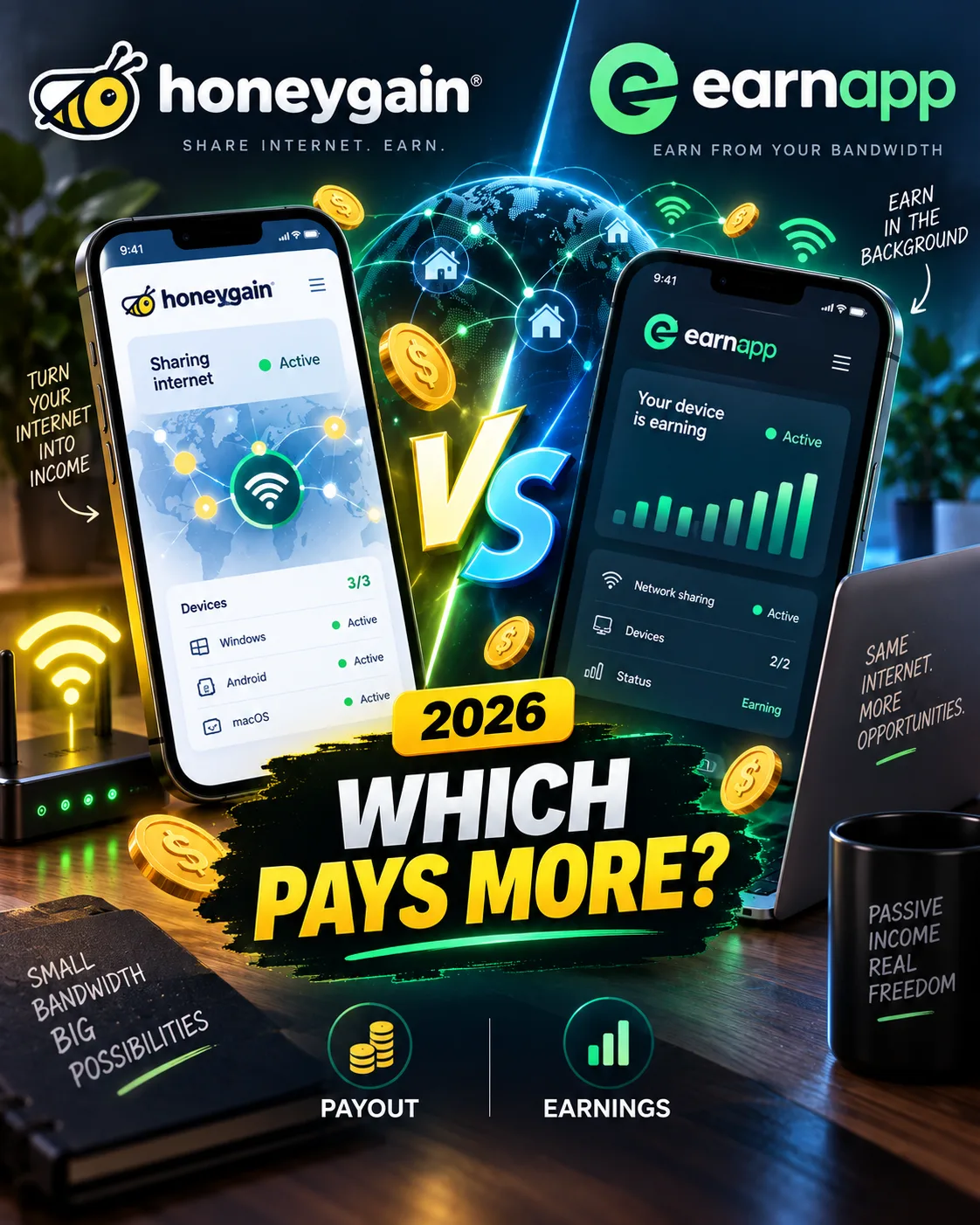
EarnApp generally pays more per month than Honeygain — with reported realistic ranges around $1 to $8 versus $0.50 to $5 — but Honeygain has the better-documented privacy framework and a clearer opt-in process. Neither is a meaningful income source, and neither is risk-free.
This comparison covers how each app actually works in 2026, what each pays, how payouts differ, what the security and privacy trade-offs really are, and which one is the better fit depending on whether you prioritize monthly earnings or minimizing exposure. If you want to try Honeygain, you can install it here: join Honeygain.
What Honeygain and EarnApp actually do
Both apps sell access to your residential internet connection. You install the app, it runs in the background, and it routes traffic from paying customers through your IP address. You receive a small payment for the traffic carried. Neither app tells you who the customers are or what they do with your connection.
The difference is in the model:
- Honeygain pays per gigabyte of traffic carried. It is a smaller, independent company registered in Estonia and markets itself on transparency and opt-in consent. You can start here: Honeygain registration.
- EarnApp is owned by Bright Data, one of the largest residential proxy providers in the world. According to EarnApp's published updates, in August 2025 it changed from a per-gigabyte model to a pay-per-time model, which altered how much users could expect to earn and how the app behaved on different devices.
That ownership difference matters. Honeygain is a proxy marketplace operator; Bright Data is the largest commercial proxy network in the industry, and EarnApp is one of its acquisition channels. Both are legal, both pay, and both carry the same fundamental privacy trade-off.
Earnings: what each app really pays in 2026
| Metric | Honeygain | EarnApp |
|---|---|---|
| Payment model | Per GB of traffic carried | Per device per day (since Aug 2025) |
| Typical per-device monthly range | $0.50 – $5 | $1 – $8 |
| Best-case monthly (multiple devices, fast connection) | $5 – $10 | $8 – $15 |
| Payout threshold | $20 | $2.50 (lower threshold) |
| Payout methods | PayPal, JumpTask (crypto) | PayPal, Amazon gift card |
| Availability | Global, but demand varies sharply | Global, with more consistent demand |
The earnings are small in both cases. A typical user running one device on a standard home connection will see a few dollars a month at most, and sometimes less. Even users with multiple devices and a fast fiber connection rarely exceed $10 per month on either app. These figures are reported ranges based on community feedback and platform documentation; actual earnings vary by location and connection.
The lower payout threshold on EarnApp is a practical advantage: you can cash out at $2.50 instead of waiting to accumulate $20 on Honeygain. That matters because reaching $20 on Honeygain can take several months at typical earnings.
Payment methods and thresholds
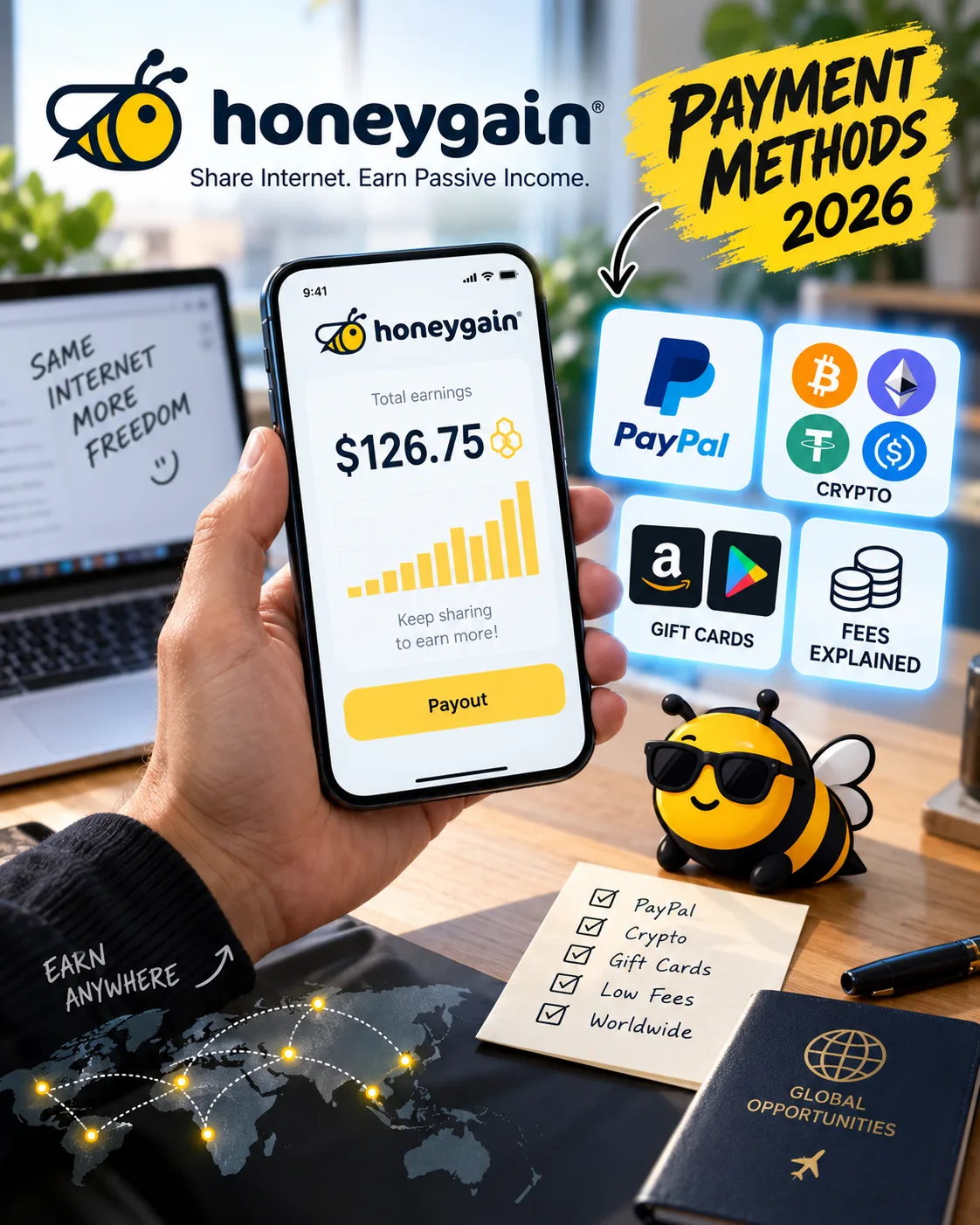
Honeygain pays via PayPal or JumpTask, a crypto platform where you receive JMPT tokens. The threshold is $20 on both routes according to the platform's current terms. For most users, that means several months between the first dollar earned and the first dollar withdrawn.
EarnApp pays via PayPal or Amazon gift card, with a threshold of around $2.50 according to its current terms. That is materially lower and makes the first payout much faster. For users in the US, UK, Canada and Australia, both payout options work reliably, though PayPal is the more flexible route since Amazon gift cards are region-specific.
Neither app supports direct bank transfer according to their current payout documentation. In markets where SEPA or Interac would be the natural choice, both apps effectively require PayPal as the intermediate step.
Security and privacy: which one is safer?
Neither app is safe in the sense of being risk-free. Both expose your residential IP to third-party traffic. The differences are in how transparent they are about it and what safeguards are in place.
| Aspect | Honeygain | EarnApp |
|---|---|---|
| Company | Honeygain OÜ (Estonia), independent | Bright Data (Israel/US), major proxy operator |
| Privacy framework | Public privacy policy, claims GDPR compliance | Covered by Bright Data's privacy framework, less user-facing |
| Opt-in process | Explicit consent screen during onboarding | Simpler onboarding, less explicit |
| Encryption | States traffic is encrypted in transit | Similar encryption claims |
| Traffic inspection | Claims no traffic content is inspected | Claims same, but Bright Data's commercial model raises more questions |
| Withdrawal of consent | Deleting the app ends participation | Deleting the app ends participation |
The practical distinction is this: Honeygain markets itself on user trust, and its onboarding reflects that. EarnApp is a channel for a much larger proxy business, and its privacy documentation is correspondingly less focused on the end user. Whether that makes Honeygain "safer" depends on whether you take the company's claims at face value.
What neither app can change: your IP is used by third parties, and you cannot see or control what they do. If a customer uses your IP for scraping, spam, ad fraud or other grey-area activity, your IP reputation can be damaged. That is the single most common practical complaint from long-term users of both apps.
Risks common to both apps
The risks are structural, not specific to one app:
- IP reputation damage. Your address can end up on blocklists if customers use your connection for questionable purposes. Once flagged, you may see more CAPTCHAs, blocked access to Cloudflare-protected sites, or service denials.
- ISP terms exposure. Most residential ISPs prohibit reselling or commercial use of the connection by third parties. No known case has led to termination for bandwidth sharing on a residential plan, but the risk exists and is higher on business connections.
- Privacy implications. You are selling access to your home IP. Traffic is routed through your connection by parties you cannot see. Even with encryption, the metadata pattern is still visible.
- Tax obligation. Earnings are income in every major market, subject to the normal thresholds. Small amounts rarely matter in practice, but the obligation exists.
- Business model risk. If either app changes its payout terms or shuts down, your accumulated balance may be lost. EarnApp's 2025 model change is a recent example of terms shifting.
Which one is better for you?
| If you... | Choose |
|---|---|
| Want the lowest payout threshold | EarnApp |
| Want to avoid a company that is primarily a proxy operator | Honeygain |
| Want the highest monthly earnings | EarnApp |
| Want the clearest opt-in and privacy documentation | Honeygain |
| Want the widest device support | EarnApp (more consistent device compatibility) |
| Want crypto payouts | Honeygain (via JumpTask) |
| Care more about minimizing exposure than maximizing income | Neither — consider not using bandwidth apps at all |
Many users run both simultaneously. There is nothing technically wrong with that — both apps can coexist on the same device or on different devices in the same network, and they track traffic independently. Just be aware that running two bandwidth apps compounds the exposure to your IP without meaningfully improving the income.
If you want to try Honeygain, you can sign up here: Honeygain registration.
How to reduce risk if you use either app
- Isolate the app. Run it on a dedicated mini-PC or in a separate network segment (VLAN). Do not run it on the computer you use for banking, work or email.
- Do not use a business connection. Business plans have stricter commercial restrictions and are more actively monitored.
- Monitor your IP reputation. Sites like MxToolbox or WhatIsMyIP show whether your IP is on common blocklists. Check periodically.
- Read your ISP's terms. Verify whether your contract explicitly prohibits sharing your connection with third parties.
- Do not count the income. Treat the earnings as a curiosity, not a budget line.
- Withdraw as soon as you reach the threshold. Do not let a balance accumulate on a platform that could change its terms at any time.
- Consider the alternative. If your goal is to earn without exposing your IP, task-based GPT sites pay more per hour and do not require routing traffic for strangers.
For readers who want to earn a modest amount without the IP exposure, a platform like Swagbucks is a reasonable starting point: create a Swagbucks account. Earnings are still small, but you keep your IP to yourself, and there is no ongoing bandwidth contribution.
FAQ
Does Honeygain or EarnApp pay more?
EarnApp generally pays more per month, with reported ranges of $1 to $8 for a single-device setup versus $0.50 to $5 on Honeygain. Both figures are small and depend heavily on your location, connection speed and the demand from the proxy network in your area.
Is Honeygain safer than EarnApp?
Honeygain has better-documented privacy practices and a clearer opt-in flow, which some users interpret as "safer." But both apps sell access to your residential IP, and neither changes the fundamental exposure: third parties route traffic through your connection and you cannot see what they do.
Can I run Honeygain and EarnApp at the same time?
Yes, and many users do. Both apps can run on the same device or different devices in the same network, and they track traffic independently. The trade-off is that running two apps compounds the IP exposure without meaningfully improving income.
What is EarnApp's payout threshold?
Around $2.50, which is significantly lower than Honeygain's $20. That makes the first withdrawal much faster on EarnApp, though the total amounts are small in either case.
Do Honeygain and EarnApp work on mobile?
Both have Android apps. Honeygain's iOS support has been limited in some regions; EarnApp has broader mobile coverage. On mobile, earnings are typically lower than on desktop or a dedicated device because connections change more frequently.
Is Honeygain legal?
Yes, in the US, UK, Canada, Australia and EU. There is no law against sharing your own bandwidth. The risk is contractual — your ISP's terms of service may prohibit it — but no known case has led to enforcement against a residential customer.
Will these apps slow down my internet?
The impact is usually minimal for typical home connections, because the traffic is routed in the background and throttled. On slow connections or during peak usage, both apps can occasionally affect performance. You can pause the apps when needed.
Can I use these apps on a business connection?
Technically yes, but you should not. Business internet contracts almost always include explicit prohibitions on reselling or commercially exploiting the connection, and enforcement is more active than on residential plans. Running either app on a business connection is a real contractual risk.
The bottom line
Honeygain and EarnApp are both legitimate, both pay, and both are small earners. EarnApp pays more per month and has a lower payout threshold; Honeygain has better privacy documentation and a clearer opt-in process.
If you decide to try either app, isolate it on a device you do not use for anything sensitive, avoid business connections, monitor your IP reputation, and treat the earnings as a curiosity rather than income. If you want to test Honeygain specifically, you can install it here: join Honeygain. If your goal is to earn a modest amount without exposing your IP at all, a task-based GPT site like Swagbucks — which you can sign up for here: create a Swagbucks account — is a safer choice.
Get the Ultimate GPT Insider Guide🚀
Learn how survey disqualifications work and proven ways to qualify for more studies. 100% Free.
LootHub.org
Recommended posts
Continue with these related reward guides.
 VERIFIED 2026
Honeygain vs EarnApp vs PacketStream vs Traffmonetizer vs Repocket: Real Passive Income Ranking (2026)
 VERIFIED 2026
Is Honeygain Safe? Real Earnings, Legal Risks & Better Alternatives (2026)
 VERIFIED 2026
Honeygain Earnings by Country 2026: Tier 1 vs Tier 2 — Real Numbers
 VERIFIED 2026
Honeygain Content Delivery Explained 2026: How to Earn More Credits
 VERIFIED 2026
Honeygain & Your ISP 2026: Contract Clauses, Legal Grey Areas and What to Check
 VERIFIED 2026