Peer2Profit and Astroproxy: The Dark Side of Bandwidth Sharing (2026 Investigation)
 VERIFIED 2026
Quick answer
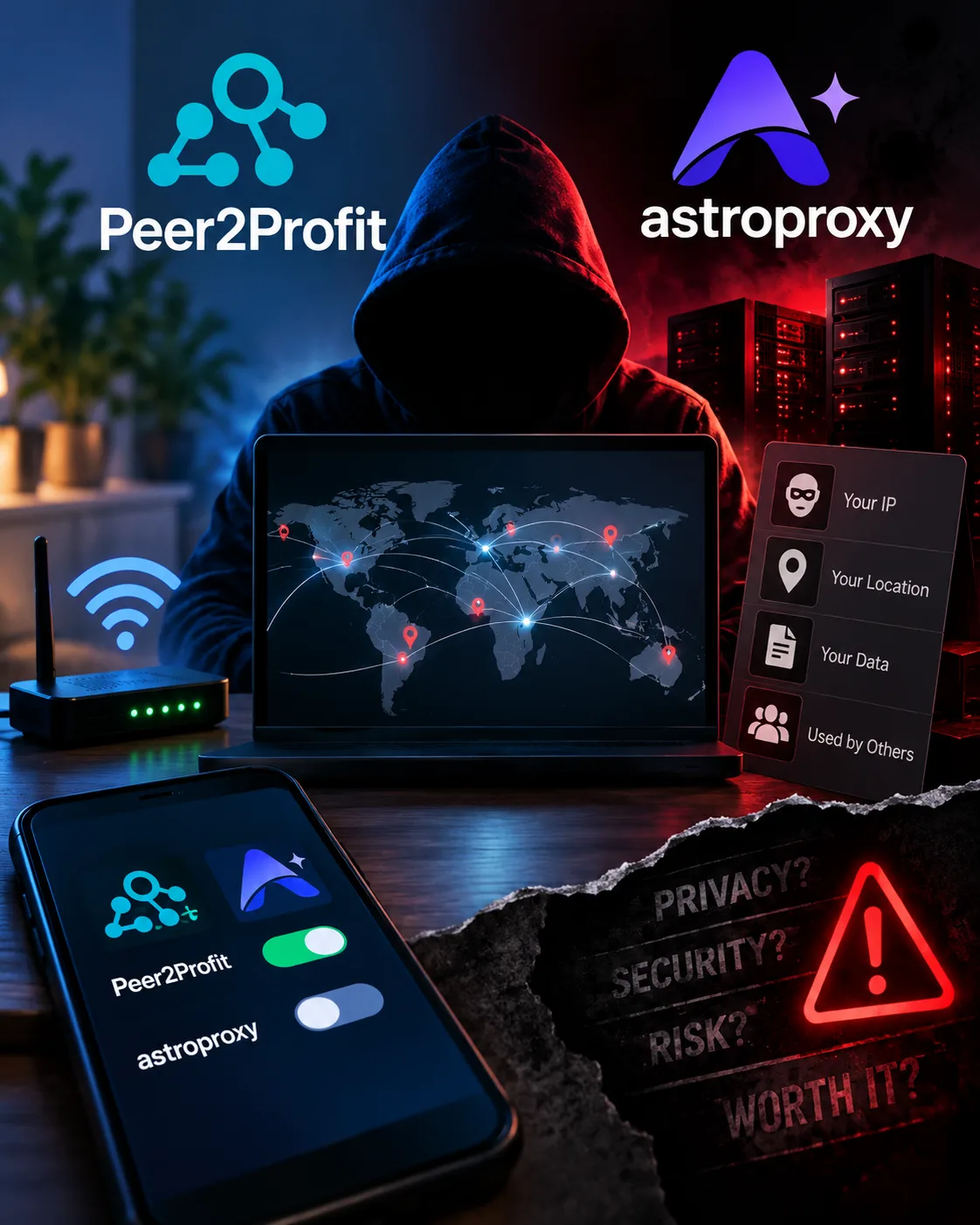
Peer2Profit is not malware. It installs through official channels with your full consent. Standard antivirus tools and threat intelligence feeds do not flag it. That is precisely what makes it a security problem. A 2026 Silent Push investigation confirmed that Peer2Profit directly feeds Astroproxy, a commercial proxy service that resells access to your residential IP address at up to 27 times what you are paid. Over a 72-hour observation window, researchers identified 117,224 unique IPs across Astroproxy's residential, mobile, and datacenter pools — the residential pool alone adding over 1,000 new IPs per hour .
The investigation went further than simply confirming the relationship. Researchers demonstrated that enrolled Peer2Profit nodes could be used to reach internal network resources — including a residential router's admin interface — through a DNS bypass that circumvented Astroproxy's own IP-range restrictions. For an employee running Peer2Profit on a corporate device or a home office connected to company infrastructure, the implications are significant. This is not a story about a scam app stealing your data. It is a story about a legitimate app that turns your connection into someone else's product — and the legal and security risks that follow.
What Peer2Profit and Astroproxy Actually Do
Peer2Profit is a bandwidth-sharing application. You install it on your device, it runs in the background, and it routes internet traffic through your connection. In exchange, you receive a small payment based on the amount of traffic that passes through your IP address. The platform is available on Windows, macOS, Linux, Android, and iOS, and has a withdrawal minimum of just $2, one of the lowest in the category.
Astroproxy is a commercial proxy service. It sells access to residential, mobile, and datacenter IP addresses to businesses and individuals who want to route their traffic through someone else's connection. The use cases are legitimate in many cases: price comparison, ad verification, market research, and geographic testing all rely on residential proxies.
The connection between the two was suspected for years but not documented until the Silent Push investigation. The researchers enrolled a controlled residential device in Peer2Profit and later detected its IP address in Astroproxy's proxy pool. This confirmed an operational relationship: Peer2Profit recruits users and pays them for bandwidth; Astroproxy resells that bandwidth commercially.
The commercial gap is stark. Peer2Profit reportedly pays residential users around $0.28 per GB. Astroproxy sells residential proxy traffic for $7.60 per GB. That is the business model in one line: you receive a fraction of a fraction, and the platform captures the rest.
The Silent Push Investigation: What Was Found
The Silent Push report, published in August 2026, is the most detailed public analysis of the Peer2Profit–Astroproxy relationship to date. The key findings are below.
| Finding | Detail |
|---|---|
| Operational relationship confirmed | Silent Push enrolled a device in Peer2Profit and detected its IP in Astroproxy's pool |
| Unique IPs identified in 72 hours | 117,224 across residential, mobile, and datacenter pools |
| Residential IP growth rate | Over 1,000 new IPs added per hour |
| Commercial markup | Up to 27x the amount paid to the user |
| Internal network access demonstrated | Enrolled node reached a residential router admin interface via DNS bypass |
| Malware classification | Not classified as malware — installs with user consent through official channels |
The DNS Bypass: How Internal Resources Were Reached
The most concerning finding involved internal network access. Astroproxy blocked direct requests to private IP ranges — the address blocks typically used by routers, NAS devices, and other local systems. But the researchers found the restriction could be bypassed with nothing more than a domain name resolving to an internal IP address. Using an enrolled Peer2Profit node available through Astroproxy, the team reached a residential router's management interface and downloaded a PNG file as proof of access.
This matters because it means the exposure is not limited to your public IP address. Depending on network configuration, proxy subscribers could potentially reach local devices — routers, smart-home equipment, storage systems, and other services accessible within your network. For a home user, that is uncomfortable. For an employee running Peer2Profit on a corporate device or a personal device connected to an office network, it is a serious security risk.
The report notes that the provider was responsibly notified before publication but did not remediate the issue.
The Scale Problem: Why This Is Not a Niche Side Hustle
One of the most revealing aspects of the investigation is the sheer scale of the network. Over 117,000 unique IPs in 72 hours, with residential IPs growing by over 1,000 per hour, is not the footprint of a small passive income app.
This scale makes the network difficult for security teams to monitor. Proxy nodes rotate too fast and originate from too many legitimate ASNs — the autonomous systems that identify internet service providers — for traditional IP reputation-based detection to keep up. An IP can appear benign one hour and operate as a proxy exit node the next. Reactive approaches to security simply cannot match that rotation speed.
The practical implication for organisations is straightforward: an employee installing Peer2Profit on a work device or a home office machine may be exposing company infrastructure to external parties without triggering a single security alert. The app is not malware. It does not need to be. It does exactly what it says it will do — the risk is in what the downstream proxy network does with that access.
Peer2Profit vs Honeygain: Is One Safer Than the Other?
The obvious question is whether Peer2Profit is riskier than better-known alternatives like Honeygain. The honest answer is that the fundamental risk — your IP address routes unknown traffic — applies to every bandwidth-sharing app. The differences are in transparency, track record, and downstream partnerships.
| Factor | Peer2Profit | Honeygain |
|---|---|---|
| Payout threshold | $2 | $20 |
| Typical monthly earnings (per device) | $1–$5 | $2–$8 |
| Trustpilot rating | 2.4/5 (Poor) | Mixed (varies by region) |
| Documented downstream proxy relationship | Yes — Astroproxy (confirmed by Silent Push) | Not publicly documented in the same detail |
| Internal network access demonstrated | Yes — DNS bypass reached router admin interface | Not demonstrated in public research |
| Platforms supported | Windows, macOS, Linux, Android, iOS | Windows, macOS, Linux, Android |
| Withdrawal methods | PayPal, crypto, bank transfer | PayPal, JumpTask, crypto |
Peer2Profit's $2 payout threshold is genuinely lower than Honeygain's $20, which makes it easier to test the platform without a long commitment. But the Trustpilot rating for Peer2Profit sits at 2.4 out of 5, with reviewers describing the dashboard as glitchy and reporting that payouts became difficult after the platform reduced its traffic rates in March 2026. Honeygain, while not without criticism, has a longer track record and a larger user base.
The Silent Push investigation did not document a comparable downstream relationship for Honeygain. That does not mean Honeygain's traffic is clean — Trend Micro has documented shady and malicious activity moving through bandwidth-sharing networks generally. But the specific, confirmed Peer2Profit–Astroproxy pipeline and the demonstrated internal network access make Peer2Profit a harder case to defend.
The Legal Risk: Secondary Liability and Criminal Traffic
Beyond the security exposure, there is a legal dimension that bandwidth-sharing users often overlook. In Germany and several other European jurisdictions, rights-holders have used a "secondary liability" doctrine to hold internet connection owners responsible for activity traced to their IP address, even if the owner was not directly involved. The reasoning is simple: you are responsible for securing your connection, and if you share it — willingly or not — you bear some of the risk.
The same logic applies to criminal traffic. If a proxy subscriber uses your IP address for fraud, credential stuffing, or any other illegal activity, the trail leads back to your connection before it leads to anyone else. A documented case in a German forum involved a Honeygain user who received a criminal complaint after an eBay classifieds fraud and a DDoS attack were traced to his IP address. The public prosecutor's office investigated him, and he had to prove his innocence.
The Peer2Profit investigation did not document a specific criminal case involving the platform. But the internal network access demonstration — reaching a router admin interface through an enrolled node — suggests that the technical capability exists. Whether that capability has been used maliciously is a separate question. The point is that the risk is real, and it is not hypothetical.
For users in Germany, this intersects with the question of whether bandwidth sharing constitutes a business activity requiring registration. If you are earning money by sharing your connection, the tax office may view it as a commercial activity. The amounts are small — $1 to $5 per month for most Peer2Profit users — but the registration obligation under § 14 GewO exists regardless of profit. This is a separate issue from the security risk, but it is part of the same picture: bandwidth sharing is not a neutral activity.
Safer Alternatives for Passive Income
If you want passive income without the specific risks documented in the Silent Push investigation, there are alternatives. None of them eliminate the fundamental trade-off — you are always giving something up in exchange for money — but some are more transparent than others.
GPT Sites with Active Tasks
Platforms like Freecash, Swagbucks, and PrizeRebel pay for tasks you complete yourself. You do not route unknown traffic through your connection, and you do not expose your IP address to third parties. The legal situation is clear: you provide a service and receive compensation for it. Freecash offers SEPA withdrawals for European users, which makes documentation easier.
Cashback Apps
Rakuten, TopCashback, and Ibotta pay you a share of your purchase back without requiring you to share your internet connection. The earnings are tied to your spending, but there is no legal risk and no security exposure. For a household that shops online regularly, cashback can produce $20–$40 per month with zero ongoing effort.
Survey Panels
Prolific, Pinecone Research, and UserTesting pay for participation in surveys and usability tests. You do not hand over your IP address, and you provide a clearly defined service. Earnings are modest, but the risk profile is simple.
What About Other Bandwidth Apps?
If you are determined to use a bandwidth-sharing app, Honeygain remains the most established option. It has a longer track record, a larger user base, and — as of the Silent Push investigation — no publicly documented relationship with a commercial proxy service of Astroproxy's type. That does not make it risk-free.
Frequently Asked Questions
Is Peer2Profit a scam?
Peer2Profit is not a scam in the sense that it does not steal money or refuse to pay. It is a legitimate bandwidth-sharing app that pays users for their traffic. However, its Trustpilot rating is 2.4 out of 5, with complaints about dashboard glitches and payout difficulties after the platform reduced traffic rates in March 2026.
What is Astroproxy and how is it connected to Peer2Profit?
Astroproxy is a commercial proxy service that sells residential, mobile, and datacenter IP access. Silent Push confirmed an operational relationship between Peer2Profit and Astroproxy by enrolling a controlled device in Peer2Profit and later detecting its IP address in Astroproxy's proxy pool. Peer2Profit recruits users and pays them for bandwidth; Astroproxy resells that bandwidth commercially.
Can Peer2Profit access my internal network?
Silent Push demonstrated that Astroproxy's proxy network could reach internal network resources — including a residential router's admin interface — by using a domain name that resolved to an internal IP address. This bypassed Astroproxy's direct IP-range restrictions. The demonstration was performed using an enrolled Peer2Profit node.
Is Peer2Profit malware?
No. Peer2Profit is not classified as malware. It installs through official channels with user consent and does not trigger standard antivirus or threat intelligence detections. This is precisely why it is difficult to detect — it is legitimate software that introduces security exposure without being malicious in itself.
Is Honeygain safer than Peer2Profit?
Honeygain has a longer track record and a larger user base, and the Silent Push investigation did not document a comparable downstream proxy relationship. However, both apps carry the same fundamental risk: your IP address routes unknown traffic. Trend Micro classifies both as "riskware" — not malware, but software that offloads risk onto the user.
What are the legal risks of using Peer2Profit?
In Germany and several other European jurisdictions, secondary liability doctrines can hold connection owners responsible for activity traced to their IP address. If a proxy subscriber uses your connection for illegal activity, the investigation may target you first. Additionally, earning money by sharing your connection may trigger business registration requirements in Germany.
What are the safest alternatives to Peer2Profit?
GPT sites like Freecash and Swagbucks, cashback apps like Rakuten and TopCashback, and survey panels like Prolific and UserTesting. These platforms pay for tasks you complete yourself without exposing your IP address or routing third-party traffic through your connection.
How much can you earn with Peer2Profit?
Typical earnings are $1 to $5 per month per device, depending on your region and the demand for residential IPs in your area. The payout threshold is $2, one of the lowest in the category. Given the commercial markup documented in the Silent Push investigation, the user receives a small fraction of the value generated by their bandwidth.
Should I uninstall Peer2Profit if I have it installed?
The decision depends on your risk tolerance and the network you are connected to. If you are running Peer2Profit on a personal device on a home network, the risk is primarily to your own network. If you are running it on a work device or a device connected to company resources, the risk extends to the organisation, and you should remove it and inform your IT team.
Bottom Line
Peer2Profit is not a scam, and it is not malware. It is a legitimate bandwidth-sharing app that pays you a small amount of money for something you were not using anyway. The problem is what happens to that bandwidth after it leaves your device.
The apps are difficult to detect precisely because they are legitimate. They install with consent, they do not trigger antivirus alerts, and they operate through official channels. For an individual on a home network, the risk is manageable but real. For an organisation with employees who might install such apps on work devices, the exposure is more serious.
If you want passive income without this specific set of risks, GPT sites, cashback apps, and survey panels are safer alternatives. If you are determined to use a bandwidth-sharing app, Honeygain remains the most established option — but no bandwidth-sharing app eliminates the fundamental trade-off. You are always routing someone else's traffic through your connection, and you are always carrying some of the risk that comes with it.
Get the Ultimate GPT Insider Guide🚀
Learn how survey disqualifications work and proven ways to qualify for more studies. 100% Free.
LootHub.org
Recommended posts
Continue with these related reward guides.
 VERIFIED 2026
GPT Site & Bandwidth App Scams in 2026: How to Spot Fakes & Protect Your Data
 VERIFIED 2026
IPRoyal Pawns, Peer2Profit & Repocket: The Bandwidth Apps That Actually Pay More Than Honeygain
 VERIFIED 2026