GPT Site & Bandwidth App Scams in 2026: How to Spot Fakes & Protect Your Data
 VERIFIED 2026
Quick answer
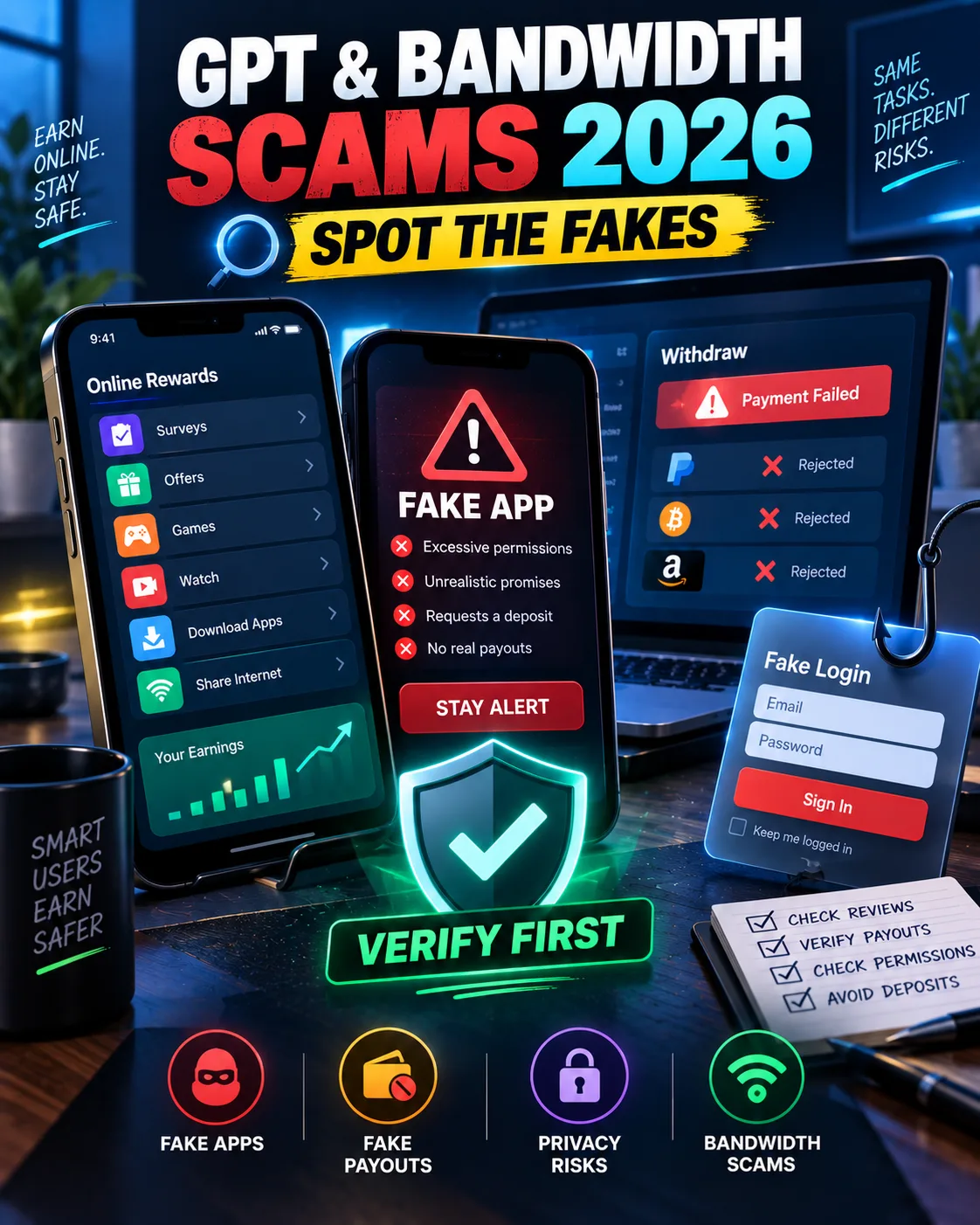
Most GPT scams follow one of three patterns: a platform that never actually pays, a cloned version of a legitimate site designed to steal login credentials, or a legitimate-looking app that exists only to collect personal data for resale.
This guide covers the scams most frequently reported in 2026, the specific red flags that distinguish them from legitimate platforms, and a practical verification process you can apply before investing time in any new GPT site, bandwidth-sharing app or reward platform.
Why the GPT niche attracts scammers
Get-Paid-To platforms operate in a space where users are already conditioned to hand over personal data — email addresses, phone numbers, demographic details, sometimes ID documents — in exchange for small rewards. That conditioning makes the niche attractive to bad actors because the boundary between a legitimate data request and a malicious one is thin.
Three structural features of the niche make it especially vulnerable:
- Low barriers to entry. Anyone can register a domain, install a rewards script and start accepting sign-ups. There is no licensing body, no accreditation and no central registry of legitimate GPT sites.
- Delayed payouts are normal. Legitimate platforms often take days or weeks to process withdrawals. Scammers exploit this by using the same excuse ("your payment is processing") indefinitely.
- KYC is expected. Because legitimate platforms do ask for ID verification at higher thresholds, a fake site asking for a passport scan does not immediately look suspicious.
The result is a niche where users must rely on personal verification rather than external trust signals. That is inconvenient but manageable, provided you know what to look for.
The most common scams in 2026
1. Clone sites that impersonate legitimate platforms
A clone site copies the design, branding and even the URL structure of a well-known platform — Swagbucks, Freecash, GrabPoints, Honeygain — and redirects users who mistype the domain or click on paid ads.
The tell is in the domain. Legitimate platforms use consistent, verifiable domains. A clone will usually modify one character, add a hyphen, use a different top-level domain (.co instead of.com), or insert a word ("swagbucks-rewards.com" rather than "swagbucks.com").
2. Fake reward apps on official stores
Some fake reward apps make it onto the App Store and Google Play, sometimes by mimicking a known brand and sometimes by presenting themselves as a generic "earn money fast" app. They promise high payouts, deliver almost nothing, and monetize by displaying aggressive ads or collecting contact data for resale.
These apps are usually removed within weeks, but the damage in the meantime can include lost time and leaked personal data. A common pattern is an app that asks for access to contacts, photos or location without any legitimate reason for a rewards platform to need them.
3. Malicious browser extensions
Browser extensions that promise to "find the best offers" or "auto-complete surveys" are a recurring problem. Some inject ads, some scrape browsing history, and some are used to carry out click fraud using your session.
4. Phishing emails posing as payout notifications
A convincing phishing email might claim that your payout is pending and ask you to confirm your account details via a link. The link leads to a cloned login page. The emails often look identical to real notification emails, with accurate branding and realistic amounts.
The rule is simple: never click a payment link from an email. Log in to the platform directly by typing its address, and check your balance there.
5. Fake KYC requests
A legitimate platform may ask you to verify your identity with a government ID and a selfie.
The distinguishing factor is timing and channel. If a platform asks for ID verification before you have earned anything, or requests documents by email, treat it as a red flag.
6. Bandwidth apps that exist only to build proxy networks
In the bandwidth-sharing space, the scam is subtler. A new app appears, offers competitive per-GB rates, and accumulates a large network of residential nodes. The app then changes its payout terms, raises the minimum withdrawal threshold, or simply disappears — leaving users with balances they cannot withdraw.
This is not always deliberate fraud; some apps fail commercially and shut down. But when a bandwidth app launches with aggressive referral incentives, generous advertised rates, and no track record, the risk of losing your balance is real.
Red flags that identify a likely scam
| Red flag | What it usually means |
|---|---|
| Promised earnings dramatically higher than industry averages | Unrealistic numbers designed to attract sign-ups before the site disappears |
| No verifiable company name, address or registration | No legal entity behind the platform, no recourse if things go wrong |
| Payout thresholds that keep increasing before you reach them | Classic tactic to avoid ever paying out |
| Requests for your Social Security number, full bank credentials or passport by email | Identity theft attempt — legitimate platforms never do this |
| Payment upfront required to "activate" your account | No legitimate GPT site charges you to join |
| Reviews that all sound identical or overly enthusiastic | Astroturfed reviews, often generated in bulk |
| Domain registered less than six months ago | New site, unproven, may disappear at any time |
| Customer support only via a Gmail address | No real business infrastructure |
| No privacy policy, or a copy-pasted generic one | No compliance effort, likely collects data without oversight |
| Pressure to sign up immediately ("offer expires in 5 minutes") | Classic scam urgency tactic |
No single red flag is conclusive. Two or three together, however, should be enough to walk away.
A practical verification checklist
Before you spend time on any new GPT site, bandwidth app or reward platform, run through these checks. The whole process takes about ten minutes.
- Check the domain. Register date, registrar and previous usage can be checked on Whois lookup tools. A domain registered less than six months ago with no history is a warning sign.
- Look for a real company. Legitimate platforms usually list a legal entity name, a business address, and terms of service that reference a specific jurisdiction.
- Read the payout section carefully. Look for specific thresholds, processing times and available methods. If the payout terms are vague or use language like "subject to change without notice," be cautious.
- Search for independent user reports. Not just reviews on the platform's own site, but discussions on forums, subreddits or community boards. Look for users reporting withdrawals that never arrived.
- Verify the app on the store. Check the developer name against the official website. Check the number of reviews and how recent they are. A huge number of five-star reviews on an app that has existed for two weeks is a red flag.
- Never reuse a password. Even on platforms you trust, use a unique password and, if available, two-factor authentication.
- Never send ID documents by email. Verification should go through a secure in-app process, not an email attachment.
- Do not install browser extensions. For rewards platforms, extensions are rarely necessary and often riskier than the reward is worth.
- Start small. Do one small offer or one survey and try to withdraw before committing more time. The first withdrawal is where most scams reveal themselves.
- Keep records. Screenshot your balance, your offer completions and any support tickets. If something goes wrong, this is your evidence.
How to protect your data
Even on legitimate platforms, data exposure is a structural feature of the GPT model. You are giving these platforms information about yourself in exchange for rewards, and that information has value. A few practices limit the downside:
- Use a dedicated email address for reward platforms, separate from your primary address.
- Do not connect social accounts. No legitimate rewards platform needs access to your Facebook or Google account.
- Limit demographic detail. Answer what is required for eligibility, and nothing beyond that.
- Check privacy policies — briefly. You do not need to read the whole thing, but the first two sections usually tell you whether your data is being sold to third parties.
- Avoid platforms based in jurisdictions with weak consumer protection if you are planning to invest significant time.
- Withdraw regularly. Do not leave a large balance sitting on any platform you have not tested with a successful payout.
What to do if you have been scammed
If you have already lost money or data to a fake platform, the response depends on what was taken.
- Change your password on any account where you used the same credentials. This is the single most urgent step.
- Enable two-factor authentication on your email and any financial accounts.
- Report the site to the hosting provider, the relevant consumer protection agency, and, if payment details were involved, your bank or card issuer.
- Report the app to the App Store or Google Play if it is still listed.
- Check your credit if you provided ID documents or financial details. In some jurisdictions you can place a fraud alert on your credit file at no cost.
- Do not pay to recover lost funds. Recovery scams are common and target people who have already been victimized once.
If you lost a balance on a platform that simply stopped paying without stealing credentials, the situation is different — you are unlikely to recover the balance, but you can warn others through forum posts, and you should treat the platform as permanently unreliable.
FAQ
How do I know if a GPT site is legit?
Look for a verifiable company name, a clear payout structure with specific thresholds, a functioning privacy policy, and independent user reports of successful withdrawals. If any of those are missing, treat the platform with caution.
Are all "earn money fast" apps scams?
Not all, but the category is heavily represented in scam listings. Apps promising significant earnings for minimal effort almost always fail to deliver. Legitimate reward apps exist, but they pay small amounts and have consistent payout histories.
Is it safe to use my real email for GPT sites?
It is safer to use a dedicated email address for reward platforms. That limits exposure if the platform is later involved in a data breach or shares your data with third parties.
Can I get my money back if a GPT site does not pay?
In most cases, no. GPT sites are not covered by the same consumer protections as regulated financial services. Prevention — verifying a platform before investing time — is far more effective than trying to recover funds after the fact.
Do legitimate platforms ever ask for a copy of my ID?
Yes, at higher withdrawal thresholds or when verification is required by payment processors. But the request should come through an in-app or secure portal, not by email, and it should be tied to a specific payout rather than requested upfront.
Are bandwidth-sharing apps safe?
The legitimate ones pay, but they all involve sharing your residential IP with third parties. That has real privacy implications. New or unproven bandwidth apps carry the added risk of never paying out at all.
Should I install a browser extension for a reward platform?
Generally, no. Browser extensions that request broad permissions have significant access to your browsing activity. If the reward for using one is small, the risk is usually not worth it.
The bottom line
Scams in the GPT and bandwidth-sharing niche are common but avoidable. The patterns are consistent: fake payouts, clones, ID harvesting and unproven platforms that disappear before paying. Almost all of them can be filtered out in ten minutes with the checklist above.
The most effective protection is behavioral. Use a dedicated email, never reuse passwords, verify the domain and company before investing time, withdraw early and often, and treat any platform promising unusually high earnings as unreliable until proven otherwise. That approach will not eliminate every risk, but it filters out the vast majority of the platforms that are designed to waste your time or take your data.
Get the Ultimate GPT Insider Guide🚀
Learn how survey disqualifications work and proven ways to qualify for more studies. 100% Free.
LootHub.org
Recommended posts
Continue with these related reward guides.
 VERIFIED 2026
Honeygain Content Delivery Explained 2026: How to Earn More Credits
 VERIFIED 2026
Is Honeygain Safe? Data Privacy, Bandwidth Risks & What You Should Know (2026)
 VERIFIED 2026
Best Honeygain Alternatives 2026: EarnApp, PacketStream, Pawns.app & More Compared
 VERIFIED 2026
Peer2Profit and Astroproxy: The Dark Side of Bandwidth Sharing (2026 Investigation)
 VERIFIED 2026
Honeygain for Beginners 2026: How to Install, Configure and Maximize Earnings
 VERIFIED 2026