Is Scrambly Safe? What Happens to Your Data (and Why Germany Is Skeptical)
FreeCash
 VERIFIED 2026
Quick answer
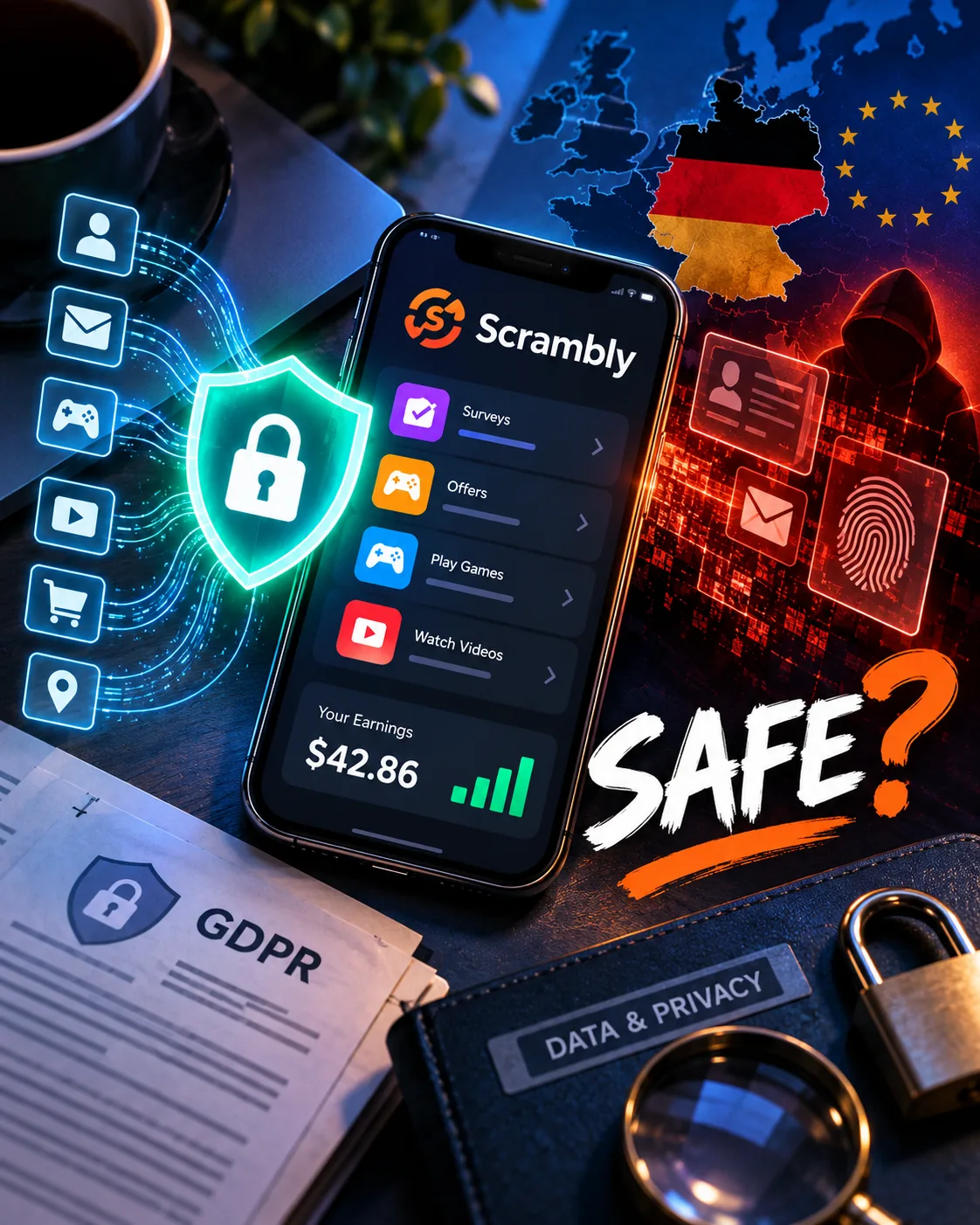
Scrambly is a legitimate Italian company that pays real money — Trustpilot shows 4.4–4.5 stars across 12,000+ reviews. But its own App Store privacy label declares that it links five categories of personal data to your identity and shares data to track you across other companies' apps and websites. Combined with mandatory ID verification through Veriff, that makes Scrambly a platform where the privacy trade-off is real, not theoretical.
This article examines what Scrambly actually collects, who it shares data with, why Veriff verification is required, and how the platform looks from a German privacy perspective — where skepticism of data-hungry apps runs deeper than almost anywhere else.
What Data Does Scrambly Collect?
Scrambly collects five categories of data linked to your identity according to its own App Store privacy label: contact info, user content, identifiers, usage data, and diagnostics. It also declares cross-app tracking using your advertising identifier.
This is the developer's own disclosure — not an accusation from a third party. The App Store privacy label is self-reported and unverified by Apple, but it reflects what Scrambly itself says it does.
Here is what each category typically includes:
| Data category | What it likely includes | Why it matters |
|---|---|---|
| Contact Info | Email address, name, possibly phone number | Standard for account creation, but shared with third parties |
| User Content | Survey responses, app usage data, screenshots of milestones | Survey responses can reveal demographic and behavioral patterns |
| Identifiers | Advertising ID, device ID, account ID | Used for cross-app tracking and ad attribution |
| Usage Data | Games played, offers completed, time spent, withdrawal history | Builds a behavioral profile that advertisers can target |
| Diagnostics | Crash logs, performance data | Standard for app stability, but still linked to identity |
Finder's review adds that Scrambly's data collection extends to income, marital status, education, gender, date of birth, biometric data, and step data — information that paints a detailed picture of who you are and what you do.
Who Does Scrambly Share Your Data With?
Scrambly shares data with 18 third-party providers, including advertising networks, analytics services, and fraud prevention partners. The company states it does not sell your data, but sharing with advertising networks for cross-app tracking is functionally similar from a privacy standpoint.
The third parties fall into three groups:
- Ad networks and offerwalls: Companies that deliver the games and offers you see on Scrambly. They receive your advertising ID to track whether you installed their game and hit milestones.
- Analytics and attribution providers: Services that measure which offers perform well and which users convert.
- Fraud prevention: Veriff and similar services that verify identity and detect duplicate accounts.
The distinction between "sharing" and "selling" matters legally — GDPR has different rules for each — but for the average user, the privacy impact is similar: your data is being used to build profiles that advertisers can target.
One important note: Counterspy's analysis found no third-party advertising, analytics, or attribution SDKs embedded in the Scrambly app. The company collects data itself and shares it through server-side integrations rather than on-device SDKs. That is slightly better for app performance but does not change the privacy outcome.
Veriff ID Verification: What You Are Actually Uploading
Before any withdrawal — even $1 — Scrambly requires identity verification through Veriff, an Estonian KYC provider. You upload a government-issued ID (front and back) and a live selfie. Veriff retains this data for 90 days in active storage and 3 years in archive.
Scrambly's own case study with Veriff explains why this is mandatory: the platform was targeted by organized fraud within weeks of launching. Users were creating duplicate accounts, spoofing locations with VPNs and residential proxies, and cashing out immediately without delivering value to advertisers. Without identity verification, Scrambly would not have survived.
This context matters. The ID check is not arbitrary bureaucracy — it is the company's defense against fraud that would otherwise make the platform unviable. But that does not change what you are being asked to hand over:
- A government-issued ID — passport, driver's license, or national ID card.
- A live selfie — biometric data that Veriff processes to match you to the ID.
- Personal details — name, date of birth, nationality, and ID number extracted from the document.
Veriff's data retention policy states that personal data is retained for 90 days in the service and then for 3 years in archive. The biometric data collected during a simple verification is substantial — Veriff processes facial geometry, liveness detection, and document authenticity signals.
The practical takeaway: If you are not comfortable uploading a government ID and a live selfie to a third-party verification service, Scrambly is not the platform for you. There is no alternative withdrawal path. The verification is hard-gated.
Why Germany Is More Skeptical Than Most
Germany has among the strongest data privacy cultures in the world — the birthplace of the GDPR's strictest interpretations. German users are less likely to accept broad data collection and cross-app tracking as a normal trade-off for small rewards. Scrambly's data practices sit uncomfortably with that culture.
Several factors make German users more cautious:
- Historical context: Germany's experience with state surveillance in the 20th century created a durable cultural preference for data minimization.
- Legal strictness: German data protection authorities (DPAs) are among the most active enforcers in the EU. The Bundesdatenschutzgesetz (BDSG) supplements the GDPR with additional requirements.
- Consumer awareness: German consumers are more likely to read privacy policies and question why an app needs access to certain data.
- Skepticism of "free" platforms: The German phrase "Wenn du nicht zahlst, bist du das Produkt" (if you're not paying, you are the product) captures a widely held view.
For German users specifically, the Veriff ID check is a bigger barrier than for users in other markets. Handing a government ID to an Estonian verification company for a $1 withdrawal feels disproportionate — and many German users decide it is not worth it.
Scrambly is available in Germany and complies with GDPR on paper — it has cookie consent mechanisms and a Data Protection Officer. But compliance with the letter of the law and alignment with German privacy culture are two different things.
Known Risks and User Complaints
The most common user complaints about Scrambly are not about outright scams — they are about tracking failures, account suspensions tied to verification checks, and delays in withdrawal processing. None of these are unique to Scrambly, but they compound the privacy trade-off.
Recurring themes from user reviews:
| Complaint | What it means in practice |
|---|---|
| Tracking failures | Completed milestones don't credit; support requires screenshots to manually apply rewards |
| Account suspensions | Verification or security flags can freeze accounts for extended periods, sometimes blocking access entirely |
| Withdrawal delays | The "19-day loop" where cashout dates keep moving back without explanation |
| Privacy concerns about ID | Users uncomfortable uploading driver's licenses and selfies for a $1 payout |
| Misleading ads | Some offers advertise higher rewards than they actually pay |
Gridinsoft's security scanner flags scrambly.io as a "suspicious site" with a trust score of 35/100, citing "unverified social media links" and "caution indicators." This is an automated assessment, not a manual audit — but it adds to the noise around the platform's reputation.
Trustpilot, on the other hand, shows 4.4–4.5 stars across 12,000+ reviews, with praise for fast payouts and low thresholds. The platform is not a scam. It is a legitimate business with operational imperfections and a data-hungry model.
How to Protect Yourself If You Use Scrambly
If you decide the rewards are worth the privacy trade-off, there are concrete steps to minimize your exposure. Use a dedicated email address, avoid linking social accounts, and complete the Veriff check only when you are ready to withdraw.
- Use a dedicated email address. Create an email specifically for GPT platforms. Do not use your primary address. This limits the damage if your data is included in a breach.
- Do not link social media accounts. Scrambly offers Google and Facebook sign-in. Each linked account adds another data point that can be correlated with your Scrambly activity.
- Complete Veriff at the last possible moment. You can earn coins without verifying. Complete the ID check only when you have enough to withdraw and have decided the platform is worth it.
- Disable cross-app tracking on iOS. Settings → Privacy & Security → Tracking → turn off "Allow Apps to Request to Track." This limits the advertising identifier Scrambly can use for cross-app tracking.
- Review the privacy policy. Scrambly's privacy policy is at scrambly.io/legal/privacy. Read it before signing up. It is not short, but it is the primary source for what the company says it does with your data.
- Exercise your GDPR rights if you are in the EU. You can file a data access request under Article 15 to see what Scrambly holds about you. You can also request deletion under Article 17.
Safer Alternatives If Privacy Is Your Priority
If Scrambly's data practices are a dealbreaker, there are platforms with lighter data footprints — though none offer the same $1 minimum or walking rewards.
| Platform | ID verification | Data collection level | Best for |
|---|---|---|---|
| Freecash | Required for some methods | Moderate | Larger offer catalog, crypto payouts |
| GrabPoints | Not required for PayPal | Moderate | Global availability, no ID for small withdrawals |
| Prolific | PayPal verification only | Lower | Academic surveys, no ID upload |
| ySense | Not required for most methods | Moderate | Survey-focused, global |
Prolific is worth highlighting for privacy-conscious users. It is a research platform that pays for academic surveys, not a GPT site. It does not require ID upload, does not share data with advertising networks, and pays through PayPal. The trade-off is fewer earning opportunities and longer survey screening.
GrabPoints is the closest GPT equivalent to a privacy-friendly option. It does not require ID verification for PayPal withdrawals, works globally, and has a more moderate data collection footprint than Scrambly. The trade-off is a $3 minimum and slower processing.
Frequently Asked Questions
Is Scrambly a scam?
No. Scrambly is a legitimate Italian company (Scrambly S.R.L.) that pays real money. Trustpilot shows 4.4–4.5 stars across 12,000+ reviews. The platform has operational issues — tracking failures, support delays — but it is not a scam.
Platform information and limitations
Scrambly states it does not sell your data. However, it shares data with 18 third-party providers, including advertising networks that use it for cross-app tracking. The distinction between "sharing" and "selling" is legally meaningful but has similar privacy implications.
Can I use Scrambly without ID verification?
You can earn coins without verifying, but you cannot withdraw any amount — even $1 — until you complete Veriff identity verification. The check requires a government-issued ID and a live selfie.
What does Veriff do with my ID?
Veriff processes your ID and selfie to verify your identity, then retains the data for 90 days in active storage and 3 years in archive. Veriff is an Estonian company subject to GDPR. It does not use your data for marketing purposes.
Is Scrambly safe for German users?
Scrambly is legally available in Germany and complies with GDPR on paper. But its broad data collection and mandatory ID verification sit uncomfortably with German privacy culture. German users should weigh the rewards against the data trade-off more carefully than users in other markets.
What are the safest alternatives to Scrambly?
Prolific is the most privacy-friendly option — no ID upload, no ad network data sharing, PayPal payouts. GrabPoints is the closest GPT alternative, with no ID requirement for PayPal withdrawals and a more moderate data footprint. Freecash is another option, though it requires verification for some withdrawal methods.
Verdict: Is the Privacy Trade-Off Worth It?
Scrambly is safe in the sense that it pays real money and is not a scam. It is not safe in the sense that it collects a broad range of personal data, shares it with 18 third parties, and requires biometric ID verification before any payout.
Whether that trade-off is worth it depends on what you value. If you want the fastest $1 withdrawal in the GPT space and are comfortable with the data implications, Scrambly delivers. If you are in Germany — or anywhere with a strong privacy culture — the calculation is different. The ID upload alone is enough to make many users walk away.
There is no wrong answer here. Scrambly is legitimate. It is just not private. If privacy matters more to you than speed and low thresholds, look at Prolific or GrabPoints instead.
Get the Ultimate GPT Insider Guide🚀
Learn how survey disqualifications work and proven ways to qualify for more studies. 100% Free.
LootHub.org
Recommended posts
Continue with these related reward guides.
 VERIFIED 2026
How to Withdraw via SEPA from GPT Sites: Full Guide for Germany & France
 VERIFIED 2026
Idle-Empire Germany 2026: Legit? SEPA Payouts, GDPR & Real Earnings
 VERIFIED 2026
Is Freecash Safe? The 2026 Data Controversy, App Store Ban, and What Really Happened
 VERIFIED 2026
GPT Site Account Banned? Causes, Appeals and How to Recover Your Balance
 VERIFIED 2026
GrabPoints Country Guide 2026: What Works in Germany, France, and the UK
 VERIFIED 2026